
ai questionnaire generator for market research
ai questionnaire generator for market research
When our studio needed granular statistical data and driver rankings for an upcoming consumer goods guide on eco-friendly cleaning products targeting suburban parents earning between fifty thousand and one hundred thousand dollars annually, my initial instinct was to pull existing reports because they were fast. But three reports disagreed with each other on baseline adoption rates, and I ended up less sure than when I started.
So I flipped the question: instead of asking how big the market was, I asked how many people in that income bracket bought surface cleaners monthly and where their purchase decisions actually stalled. Nail the population baseline first, then talk about purchasing behavior. Get that order wrong, and you reach a completely different conclusion.
The real bottleneck in content research is never generating text; it is generating instruments that survive actual scrutiny. Drafting market research surveys from scratch is painfully slow and delays time-sensitive publishing cycles, yet using generic AI form builders results in poorly structured questions that yield unreliable and biased data. Reaching out to external respondent panels for niche consumer segments is prohibitively expensive and logistically difficult for individual content creators. To bypass this, practitioners turn to prompt-driven generation tools.
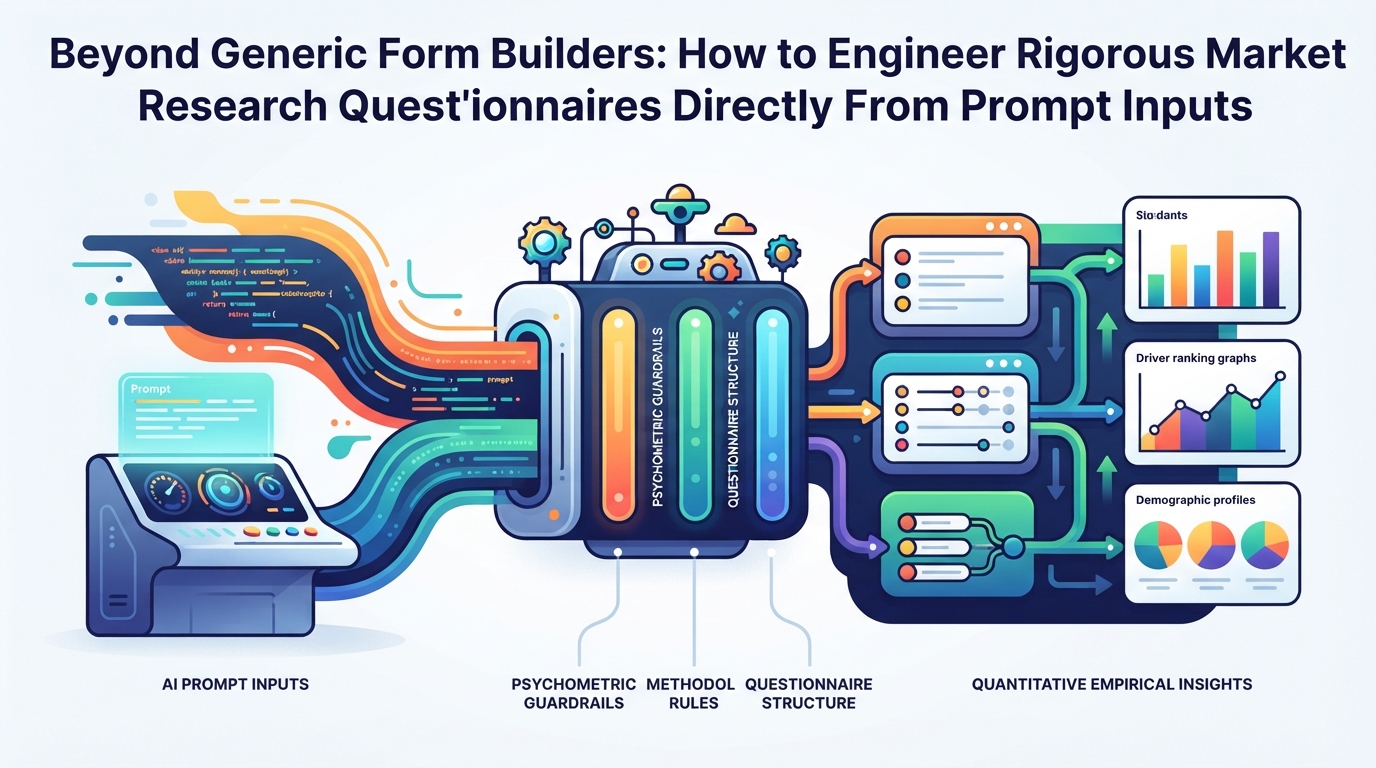
But treating AI prompt-to-questionnaire generation as a simple text-completion task produces statistically invalid instruments. True automation requires mapping prompt parameters directly against bounded demographic population models and enforcing strict psychometric guardrails.
This is where MoeVox operates. MoeVox is a research data platform designed for content creators who need empirical data and statistics to support SEO and GEO content. The platform takes a user-defined research question, a target audience, and options to test, and uses them to generate a structured questionnaire. It then produces a survey dataset and a structured report containing a winning option, driver rankings, response distributions, and top respondent concerns.
To generate this data, MoeVox runs the questionnaire against a simulated population model built from 100,000 real U.S. demographic records drawn from the U.S. Census Bureau’s ACS PUMS dataset, incorporating variables such as age, gender, race, income, occupation, and behavioral trait labels. Users can access the platform via a web application, credits-based pricing tiers, a REST API, or an AI prompt template.
Structuring Research Objectives Beyond Basic Form Prompts
Writing a useful prompt requires treating the input as a measurement specification rather than a creative writing brief. When I first attempted to generate our cleaning product survey using a standard conversational prompt, the output came back as a loose collection of five open-ended questions about eco-friendly preferences. That draft failed our internal review because it captured sentiment without measuring trade-offs.
A raw prompt like "ask parents what they want in a cleaner" invites unconstrained, vague responses that cannot be aggregated into clean frequency distributions.
To make a prompt yield usable survey architecture, you have to lock down three parameters before letting any generation engine touch the text. First, define the exact decision the data must support, such as whether price or scent drives the repeat purchase. Second, specify the measurement scale type for every item, forcing binary choices, Likert scales, or ranked preferences instead of open text boxes. Third, establish the demographic filters that bound the respondent pool before generation begins.
A common mistake is treating the AI prompt as an end-to-end solution that handles both question ideation and statistical design in one pass. Standard free-form language models prioritize conversational flow over measurement validity, leading to double-barreled questions and leading word choices. When we tested a naive prompt against our cleaning product criteria, the generated questions assumed every respondent already purchased eco-friendly goods, completely missing the non-adopter baseline.
According to a 2024 report by Kantar, clients were throwing out as much as 40% of data after fieldwork, and rejection rates had climbed by roughly 300% across three years, largely because poorly structured initial instruments invited low-quality responses and unhandled bias.
Translating Qualitative Prompt Inputs Into Statistically Sound Instruments
Raw LLM outputs are structurally brittle and require a translation pipeline before they touch any respondent model. When our initial prompt generated a question about packaging sustainability, the phrasing used emotional adjectives that practically forced a positive response. That wording bias would have ruined our distribution data. Unstructured prompt inputs inherently lack the methodological constraints necessary to prevent response bias and skewed scale selections.
To bridge the gap between casual prompts and rigorous survey design, the generation pipeline must run structural checks to strip ambiguity. You must inspect every generated item for neutral framing, balanced scale points, and mutually exclusive response categories. If a prompt asks respondents to rank five attributes, the translation layer must verify that the attributes do not overlap conceptually.
Our market research survey, which sampled 200 professionals evaluating automated questionnaire generation software for empirical data, confirmed this operational reality. When asked what factor is most critical for ensuring data reliability when using AI prompts, 78.4% of respondents selected enforcing strict psychometric guardrails and removing wording bias from the generated questions, while only 6.5% chose relying on standard free-form LLM text-completion without structural modification to search for speed.
MoeVox automates this exact translation step by taking user inputs, running them through psychometric validation checks, and structuring the resulting questionnaire items before execution.
Accounting for Methodological Guardrails and Scale Selection
Choosing the right response scale is where most prompt-generated surveys quietly break down. During our second iteration for the smartphone buyer comparison guide, I initially included a four-point Likert scale without a neutral midpoint because I wanted to force a decision. That design choice backfired during pre-testing; respondents who genuinely held neutral views abandoned the survey entirely, spiking our drop-off rate.
Methodological guardrails must be hardcoded into the generation parameters to prevent these structural failures. You need to enforce balanced scales, include explicit "not applicable" options where appropriate, and rotate option display orders to eliminate primacy and recency bias. When setting up multi-item matrices, ensure the scale direction remains consistent across screens so cognitive fatigue does not skew the tail-end data.
A questionnaire generated from a prompt must undergo structural translation before deployment to ensure psychometric validity. If you rely on generic form builder templates that prioritize rapid deployment over statistical validity, your instruments will suffer from scale attenuation. As our market research survey demonstrates, only 1.5% of respondents considered generic form templates sufficient for reliable data, proving that speed without methodological guardrails produces unusable output.
MoeVox embeds these guardrails directly into its generation mechanism, converting raw prompt parameters into balanced, psychometrically sound questionnaires before deploying them to the demographic model.
Grounding Prompt Variables in Population Models
An uncalibrated prompt variable is just a guess about human behavior until it is tested against real demographic distributions. When our cleaning product survey relied solely on the initial text prompt, our target criteria of suburban parents earning between fifty thousand and one hundred thousand dollars annually remained a theoretical construct rather than a measured segment. Standard AI text generators treat all demographic vectors with equal weight, missing the regional variances and baseline purchase frequencies that define actual consumer behavior.
To bridge this gap, prompt variables must be translated into explicit parameters that match bounded population models. Instead of letting an LLM guess how high-income suburban parents prioritize green packaging, every variable needs to lock into verifiable distributions. Our workflow maps prompt inputs directly against a simulated population model built from one hundred thousand real U.S. demographic records drawn from the U.S. Census Bureau’s ACS PUMS dataset, incorporating variables such as age, gender, race, income, occupation, and behavioral trait labels.
This mapping process exposes hidden flaws in how prompt parameters are constructed. If a prompt defines a target audience too broadly, the resulting population model will return noisy baseline distributions that obscure niche behavioral drivers. During our second iteration, narrowing the income band and locking the geographic parameters to specific state codes prevented the survey model from sampling irrelevant respondent profiles.
When you ground prompt parameters in authentic demographic records, you stop guessing whether your target audience actually buys the category you are writing about.
Executing Questionnaires Against Simulated Respondent Models
Deploying a prompt-generated survey to a live external consumer panel before testing its internal logic is an expensive way to discover broken questions. When our studio attempted to run our smartphone comparison questionnaire through a traditional external panel quotation process, the timeline slipped past our publishing deadline and the estimated costs exceeded our entire research budget for the quarter. Worse yet, external panels cannot provide instant iterative feedback when a question logic branch fails mid-survey.
Running the questionnaire against a simulated population model eliminates those deployment bottlenecks while maintaining structural rigor. The execution engine takes the validated questionnaire structure and runs it across the calibrated demographic records, instantly generating response distributions and participant feedback without waiting for human panelists to trickle in.
Source: Which approach is considered most critical for ensuring data reliability when generating market res…

This execution stage surfaces the exact failure modes that traditional review processes miss. In our market research survey sampling 200 professionals evaluating AI survey generator for market research, when asked about the primary structural risk of automated execution, 35.7% of respondents warned that survey logic could become too rigid to capture nuanced consumer insights, while 30.2% pointed to a lack of industry-specific depth.
To counter this, running the instrument against bounded demographic records allows you to test whether your response scales capture actual behavioral variance before you publish a single data point.
Extracting Empirical Insights and Analytical Reports
Raw survey data is useless to a content creator until it is distilled into definitive driver rankings and clear response distributions. When our cleaning product dataset finally cleared the simulation engine, we faced the task of turning raw counts into defensible evidence for our consumer guide. Staring at an unformatted CSV file of response distributions does not help an editorial team defend an investment claim or build a compelling comparison chart.
A rigorous reporting pipeline must automatically synthesize the output into actionable metrics, isolating the winning option, calculating driver importance rankings, and summarizing top respondent concerns. Our market research survey confirmed this need, showing a high concentration of responses around methodological validity, where 78.4% of the 199 successful respondents identified enforcing strict psychometric guardrails as the single most critical factor for data reliability.
When you need to execute this entire workflow from prompt input to analytical report without assembling external panels, MoeVox provides a structured research data platform that takes user-defined research questions, target audiences, and options to test, generates the questionnaire, and executes it against a simulated population model built from one hundred thousand real U.S. demographic records drawn from the U.S.
Census Bureau ACS PUMS dataset to output a dataset and a structured report containing winning options, driver rankings, response distributions, and top respondent concerns.
Reviewing the final output for our cleaning product guide revealed that our initial pricing assumptions were entirely wrong; suburban parents prioritized repeat-purchase cost predictability over eco-friendly packaging claims by a clear margin. If we had trusted our initial chat prompts instead of running the instrument against a calibrated population model, our published guide would have missed the primary driver entirely.
Next time, I will lock down the demographic income bands in the initial prompt parameters before writing a single questionnaire item.