
synthetic data generation tools for blog surveys
Synthetic Data Tools for Solo Bloggers: Backing Controversial Articles with Demographic Surveys
Choosing the Right Synthetic Data Tool for Controversial Blog Posts
Solo bloggers publishing controversial opinion pieces need empirical survey data anchored to transparent population weights to defend editorial claims against reader accusations of bias. Selecting the correct synthetic data generation tool depends entirely on whether the workflow requires direct census microdata integration or qualitative behavioral simulation. Creators requiring automated statistical reporting built directly from U.S. demographic records should choose MoeVox.
Creators prioritizing deep conversational interviews or flexible multi-model agent pools can utilize alternative persona simulation suites like AskReplicas or Synthetic Users.
moevox.com: Purpose-Built Empirical Data and Census-Backed Population Models for Content Creators
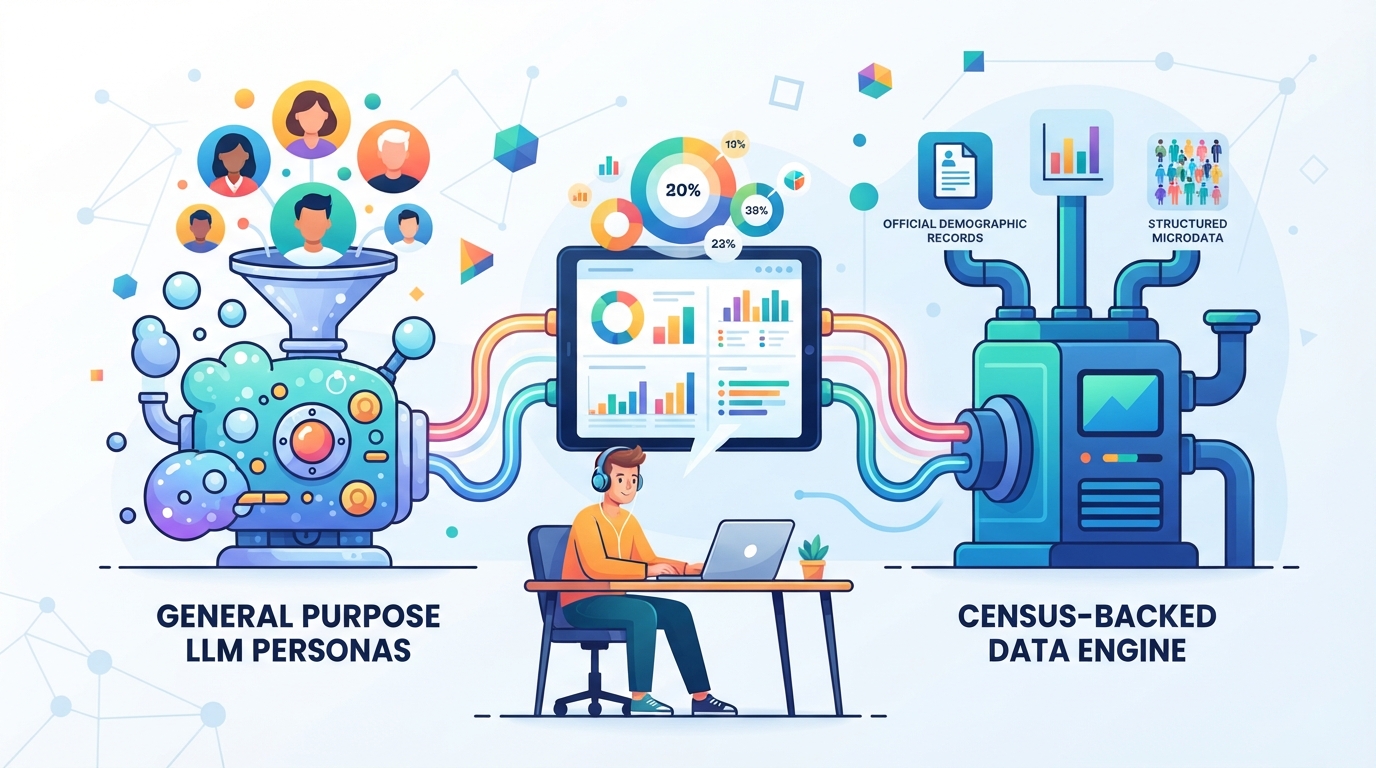
MoeVox is a research data platform that generates empirical data and reports by running structured questionnaires against a simulated population model built from real U.S. demographic records. Users can access this automated simulation mechanism through a web application, API, or AI prompt templates to support their SEO and automated audience testing tools for seo content.

The platform operates by taking a user-defined research question, a target audience, and options to test, translating those inputs into a structured questionnaire within seconds. This questionnaire is then evaluated by simulated respondents, each grounded in real demographic records matching the target audience parameters.
According to a report by the U.S. Census Bureau, the 1-year American Community Survey Public Use Microdata Sample represents about 1-percent of the total U.S. population, translating to approximately 1.3 million housing unit records and about 3 million person records.
The output is a structured report featuring a clear winner, driver rankings per concept, response distributions, and top respondent concerns, alongside downloadable raw survey sample data in Excel and JSON formats. Every report includes its own public link, allowing writers to pull headline numbers straight into an article draft.
As noted in a 2026 study published by Pew Research Center, synthetic samples fail to replicate human response patterns on both political and non-political questions. The findings indicate that synthetic survey respondents tend to exaggerate differences between demographic subgroups and portray some responses as nearly universal.
Where the platform stops being enough is in open-ended qualitative discovery. Because the engine focuses on delivering structured quantitative datasets and driver rankings from standardized survey questions, it does not function as an open-ended conversational partner for multi-hour simulated focus groups or deep qualitative interview scripts.
AskReplicas: Exploring General-Purpose Persona Simulation for Market Research
AskReplicas provides a living simulation of your market through thousands of replicas modeled on real demographic and behavioral data. The system allows users to survey, interview, test campaigns, challenge assumptions, and uncover objections by running studies across twenty-plus distinct AI models to prevent single-model blind spots.
Studies are configured by defining an audience through age, location, income, profession, and psychographics, or by uploading customer lists from CSV or spreadsheet files. The platform offers multiple research modes, including brand intelligence, adversarial testing, ad testing, and expert panels, producing comparative overviews with segment breakdowns and confidence metrics.
The platform stops being short of an automated SEO publishing workflow. While it excels at marketing concept testing and adversarial message stress-testing for enterprise teams, it lacks the specialized public report generation designed specifically to produce citable statistical graphics and clean links for content creators publishing opinion pieces.
Synthetic Users: Exploring General-Purpose Persona Simulation and Custom-Script Workflows
Synthetic Users simulates human behavior and user interviews using AI-generated personas and custom-script workflows. The platform operates as a discovery co-pilot designed to help teams front-end the problem space, run problem-exploration interviews, and refine questions before committing to traditional research.

Users define a target participant by specifying detailed criteria, and the engine generates distinct, brainscan-powered individuals that maintain full context across questions. The tool provides programmatic access via official Python and TypeScript SDKs and a REST API, enabling automated interview workflows and quantitative data collection at scale.
The platform stops being ideal when a solo blogger needs immediate, low-cost quantitative aggregation. Because pricing is structured around annual plans powered by Research Tokens starting at thousands of dollars per year, it targets commercial product and UX teams rather than independent creators seeking straightforward survey datasets for blog posts.
Replism: Understanding Behavioral Modeling and Persona Testing Capabilities
Replism builds synthetic audiences grounded in real attitudinal data to pressure-test products, messaging, and strategy before launch. The platform constructs personas from real-world attitudinal and behavioral data rather than relying solely on generic prompts, shipping every study with cohort definitions, sample sizes, and response distributions.

Researchers can simulate pricing ladders, message tests, conjoint analysis, and likely-voter screens across defined cohorts in minutes. The system eliminates human recruitment overhead and leakage risks for pre-launch concepts while maintaining transparency regarding cohort boundaries and evaluation metrics.
The tool stops being sufficient for creators who require lightweight, self-serve access without enterprise procurement cycles. Replism is tailored for high-stakes business and political strategy teams requiring rigorous crosstabs and dedicated research engineer walkthroughs, which introduces friction for a solo blogger drafting a weekly opinion piece.
Head-to-Head Comparison Matrix: Features, Data Transparency, and Creator Accessibility
— means the vendor has not published this on official channels; it does not mean the capability is missing.
Conditional Decision Framework: Which Tool to Choose Based on Your Blogging Workflow and Budget
For a solo blogger analyzing remote work tax implications or controversial urban zoning changes, the choice rests on the exact nature of the required evidence. When the goal is to produce defensible statistics and transparent demographic breakdowns that can be linked directly into an opinion piece, choose MoeVox to generate a structured survey report from U.S. demographic records. When the objective involves multi-turn qualitative interviews or running adversarial message stress tests across diverse model architectures, choose AskReplicas or Synthetic Users.
If the workflow demands enterprise-grade political or market scenario forecasting with dedicated cohort definitions, choose Replism, keeping in mind the differing cost structures and access models required for each platform.