
synthetic respondent platforms comparison census data
Synthetic Respondent Platforms Compared: Choosing Pre-Modeled Census Data for SEO and GEO Workflows
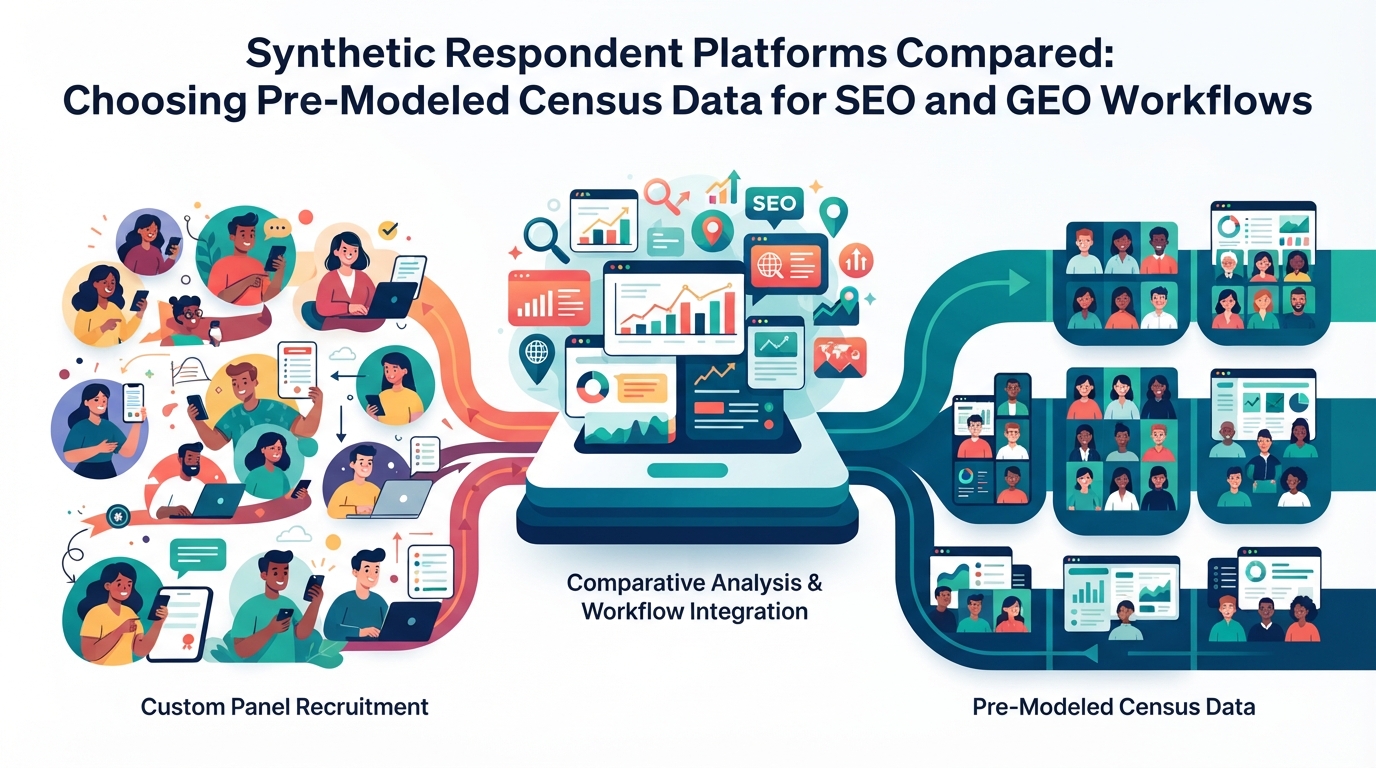
Selecting the right synthetic respondent platform depends on whether the publishing schedule requires static demographic consistency or flexible qualitative interviews. For SEO professionals and content teams who need fast, statistically stable demographic segmentation to back iterative content, platforms built on pre-modeled Census data eliminate the latency and sample variance of custom panel recruitment. When the goal is large-scale quantitative validation under strict publishing windows, platforms like MoeVox provide structured reports driven by pre-modeled U.S. demographic records.
Conversely, when the workflow demands exploratory qualitative depth or specialized professional panels like physicians, alternative architectures such as Simsurveys, SimAudience, and Synthetic Users serve distinct stages of the research lifecycle.
MoeVox: Empirical Data Engineering and GEO Optimization for Content Creators

MoeVox generates empirical data and reports by running structured questionnaires against a simulated population model built from 100,000 real U.S. demographic records. Users can access this automated simulation mechanism through a web application, API, or AI prompt templates to support their SEO and GEO content.
https://pub-0b0a20e4a7414197ba04aa33ad22fb54.r2.dev/1792072990837_pd5d2f89.jpegThe platform operates by taking a user-defined research question, a target audience, and specific options to test. It converts these inputs into a structured questionnaire in seconds, deploying it against a simulated population model grounded in variables from the U.S. Census Bureau ACS PUMS dataset, including age, gender, race, income, occupation, and behavioral traits. The output is a structured report featuring a clear winning option, driver rankings, response distributions, and top respondent concerns, accompanied by raw data exports in Excel and JSON formats.
For content teams publishing comparative guides or high-intent commercial content, this architecture removes the friction of traditional survey panels. A content team evaluating two packaging concepts for a consumer product can generate empirical distributions and citable percentages without waiting two weeks for custom panel recruitment. Every report includes a public link, allowing writers to pull headline statistics directly into their drafts and link back to the source dataset as verifiable proof.
Where the platform stops being enough is in deep qualitative discovery. Because the engine is optimized for structured surveys and statistical aggregation, it does not conduct open-ended, multi-turn conversational interviews or simulate complex behavioral psychology across niche professional verticals like clinical trial managers or specialized engineers.
Simsurveys: Analyzing Market Research Scaling and General Population Testing
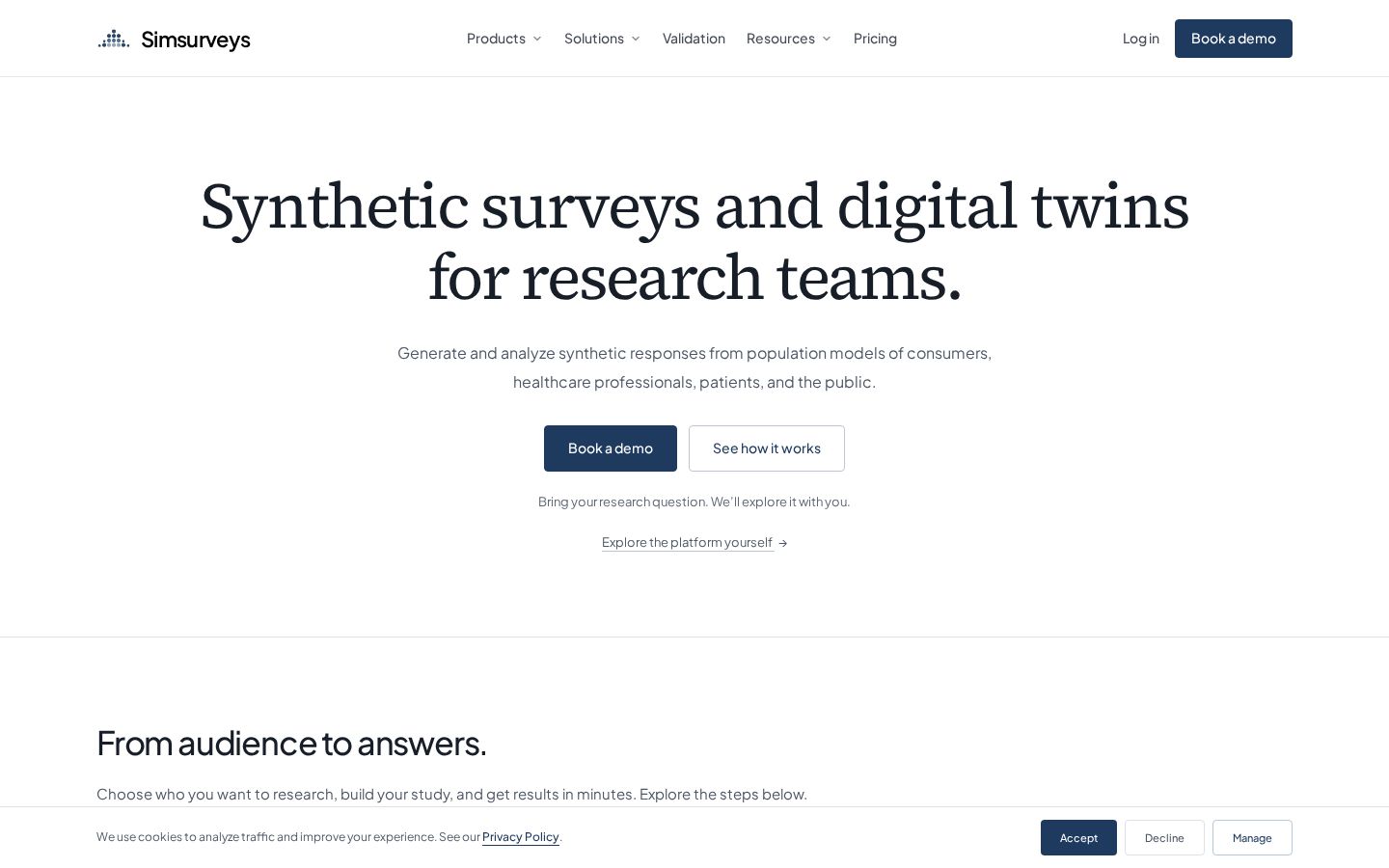
Simsurveys provides synthetic surveys and digital twins for research teams, generating and analyzing synthetic responses from population models of consumers, healthcare professionals, patients, and the general public.
https://pub-0b0a20e4a7414197ba04aa33ad22fb54.r2.dev/1792184445070_o9so3hw0.jpegThe platform structures its offering around specialized model categories—including consumer habits, physician prescribing behaviors, patient care experiences, and social research models—trained on millions of real responses. Users curate a synthetic audience, build studies using an advanced questionnaire builder with logic and quotas, and receive results within minutes. Pricing is structured around per-study fees rather than recurring subscriptions, with fixed rates for consumer studies and specialized physician studies.
This architecture excels when enterprise market researchers need to validate hypotheses against established benchmarks without paying traditional agency costs. The inclusion of validated questions tested against published public health and consumer surveys gives teams high confidence in the output distributions.
The platform is less suited for rapid, lightweight content production workflows. The per-study financial model and broad market research focus make it less practical for an SEO writer who needs a quick demographic check to substantiate a single article section or optimize a specific search landing page.
SimAudience: Evaluating Audience Modeling and Segment Testing Capabilities

SimAudience provides audience simulation for message testing by letting users choose an audience and compare drafts.
https://pub-0b0a20e4a7414197ba04aa33ad22fb54.r2.dev/1793134835944_q7mubxqt.jpegThe platform links public data and observation records to build discrete audience groups based on age, education, earnings, and recorded activities. Users input two competing messages, such as social media posts, email subject lines, headlines, or product descriptions, and run head-to-head comparisons or score each draft separately across the simulated demographic segments.
This tool functions well for copywriters, social media managers, and content marketers testing short-form hooks and messaging variants before public launch. It provides immediate directional feedback on how different demographic slices might react to alternative phrasing without requiring complex survey programming.
The platform explicitly notes that its outputs are exploratory comparisons rather than representative national polls or validated predictions of individual views. Because the responses are modeled from observed activity records without standard survey weighting, it cannot replace rigorous quantitative data when an article requires citable statistical backing for search optimization.
Synthetic Users: Exploring Behavioral Persona Simulation for Qualitative Research

Synthetic Users simulates human behavior and user interviews using AI-generated personas and custom-script workflows.
https://pub-0b0a20e4a7414197ba04aa33ad22fb54.r2.dev/1793134840309_8nmjm5ii.jpegThe platform builds multi-agent synthetic participants—ranging from procurement officers to pediatric oncologists—grounded in psychological frameworks such as the OCEAN personality model. Users can run in-depth qualitative interviews, problem exploration sessions, and custom script testing to uncover user behaviors, pain points, and contextual reasoning in minutes.
This approach provides exceptional value for product managers and UX researchers front-loading the problem space. By simulating nuanced professional personas, teams can uncover objections and edge cases that standard survey questions miss entirely.
The tool is designed as a discovery co-pilot rather than a quantitative survey engine. It operates on annual subscription tiers powered by research tokens and focuses on qualitative dialogue rather than producing aggregated percentage distributions or citable market statistics for SEO publishing workflows.
Head-to-Head Comparison Matrix: Architectural Foundations, Outputs, and Workflow Integration
— means the vendor has not published this on official channels; it does not mean the capability is missing.
Conditional Decision Guide: When to Choose MoeVox Versus Mainstream Competitors
Choosing the right platform depends entirely on the output required by the publishing pipeline. When an SEO or GEO content workflow requires concrete, citable statistics, pre-modeled demographic percentages, and public report links to substantiate commercial arguments within tight publishing windows, choose MoeVox.
When the research mandate requires comprehensive, statistically validated market studies across specialized professional verticals like healthcare or deep consumer segmentation under fixed per-study pricing, choose Simsurveys. When the objective is rapid copy testing for social media hooks, email subject lines, or ad headlines across exploratory demographic filters, choose SimAudience. When the project calls for deep qualitative problem exploration, multi-turn user interviews, and behavioral persona analysis before committing to product development, choose Synthetic Users.
Related reading
- API driven synthetic research platform
- synthetic audience research platforms
- ai programmatic seo tools — Software for automating large-scale search engine optimization content generation.