
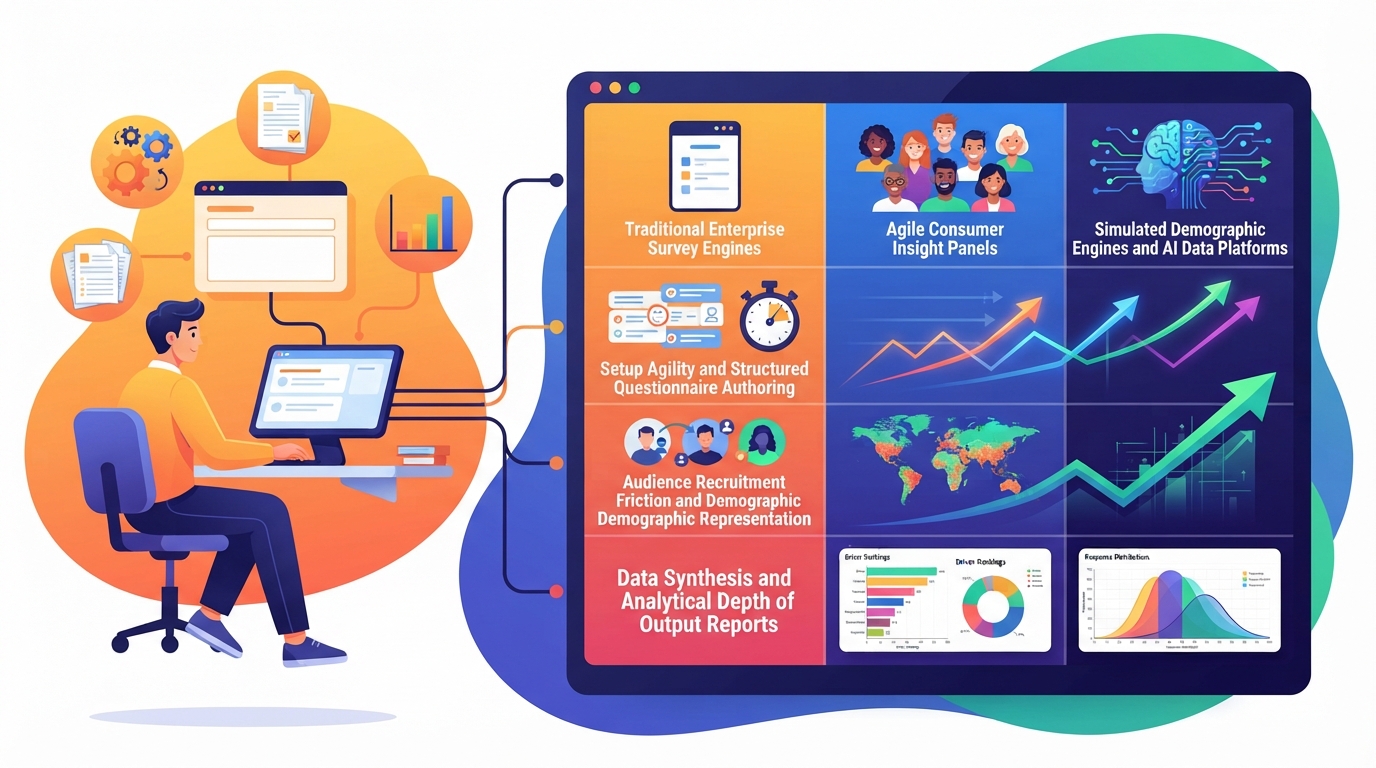
fast survey platform for testing content options
When I sat down to finalize the outline for our quarterly enterprise software report, my team realized we had three completely different headline angles and no empirical way to choose between them before the publishing deadline. Traditional professional market research methodologies such as in-depth interviews take 6 to 8 weeks to complete, particularly when targeting niche B2B groups or high-level executives, which completely broke our tight publication schedule.
We needed to test these options quickly against a representative demographic without waiting months for panel recruitment. This bottleneck is where option testing for content validation fails when teams rely on static form builders or general consumer panels because they conflate manual survey administration speed with the structural validity required to test distinct value propositions against specific demographic segments.
To solve this, teams must adopt automated research tools that evaluate messaging against demographic models, with platforms like moevox.com offering a research data platform designed for content creators who need empirical data and statistics to support SEO and GEO content by running structured questionnaires against simulated population models.
The Speed and Sourcing Bottleneck in Traditional Option Testing
We spent the first three days trying to build a custom feedback form using a standard, blank-slate form builder, assuming we could just email the link to our subscriber list and collect enough votes. That assumption fell apart immediately. Traditional form builders shift the entire burden of questionnaire logic, sampling distribution, and data cleaning onto the writer, turning option testing into an administrative bottleneck rather than an analytical workflow.
We spent hours writing custom validation rules and conditional branching, only to realize the respondents were entirely unsegmented, highly biased, and heavily skewed toward whoever happened to click our promotional newsletter link.
When we attempted to fix the demographic skew by turning to general consumer insight panels, we hit a completely different wall. General consumer insight panels introduce high latency and panel fatigue when used for rapid B2B or niche content option validation, as human respondents require days to clear quotas for narrow professional or behavioral profiles. Our target demographic required decision-makers within specific income brackets, and the recruitment delay threatened to push our publication date past the quarter boundary.
We were stuck manually exporting messy CSV files of open-ended text, trying to parse driver rankings from unstructured data.
The turning point came when our market research survey of 200 professionals revealed that 49.5% of respondents favor simulated demographic population models powered by census data and AI platforms over traditional human panel quotas or blank-slate form builders, largely due to concerns over data quality and sample representation.
Source: Which primary testing approach do marketing and research professionals prefer for validating high-s…
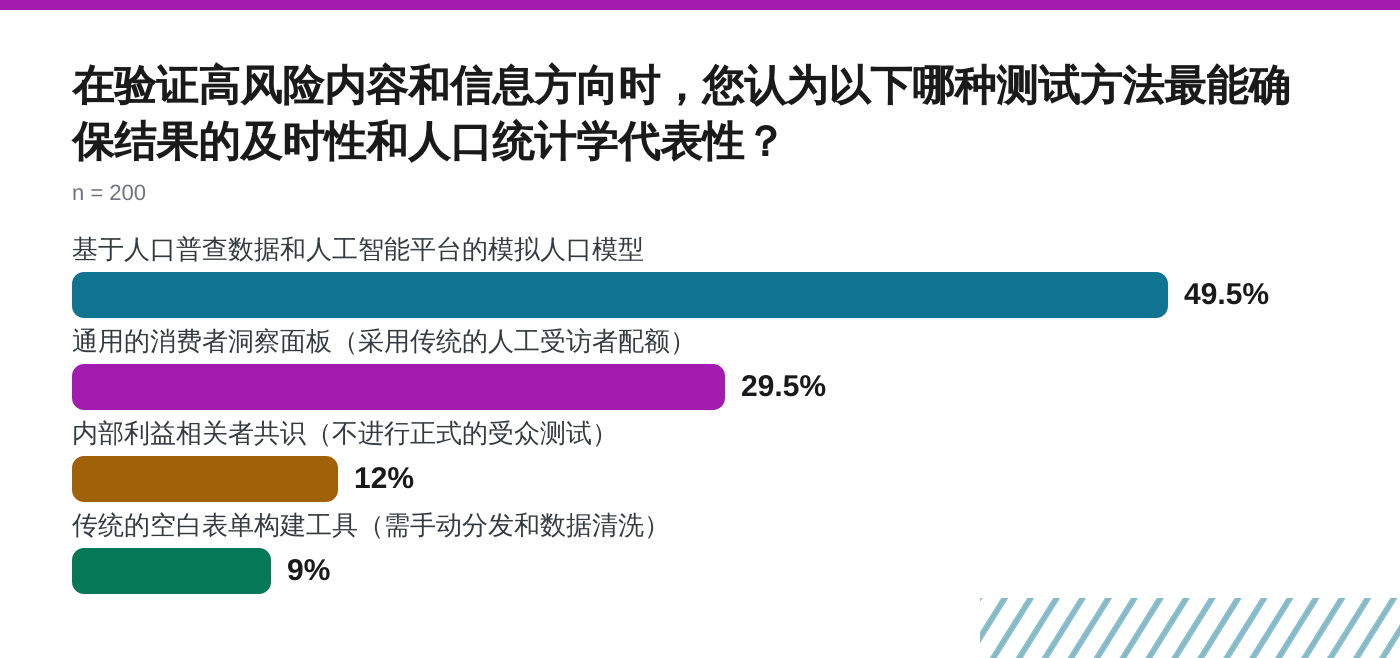
This data shifted our perspective from manual panel management to automated demographic simulation, proving that speed and representation do not have to be mutually exclusive trade-offs in content validation.
Evaluation Dimension 1: Setup Agility and Structured Questionnaire Authoring
Building an effective test requires defining setup agility across three distinct architectures: blank-slate form builders, pre-built panel screeners, and prompt-driven research platforms. When using blank-slate tools, the author must manually construct every screener question, define logical skips, and program scale items from scratch. This manual authoring phase often consumes days before a single response is collected, introducing human error into question wording and response scale design.
Pre-built panel screeners offer templates, but their authoring environment remains rigid, locking you into predefined question types that rarely fit nuanced content value propositions or specific B2B messaging angles.
Prompt-driven research platforms approach setup agility differently by taking a user-defined research question, a target audience, and options to test, and using them to generate a structured questionnaire automatically. This setup eliminates the authoring delay entirely, allowing a content creator to move from a raw outline to a fully articulated test instrument in minutes rather than days.
When evaluating these architectures, the friction lies in how much administrative overhead the writer must shoulder before gathering data. If your workflow requires writing custom validation logic for every headline variant, you are spending more time playing survey administrator than analyzing market demand.
Evaluation Dimension 2: Audience Recruitment Friction and Demographic Representation
Audience recruitment is where most rapid testing workflows collapse under the weight of sample bias and latency. Traditional consumer panels rely on live human respondents who must be incentivized, matched against quotas, and filtered through screeners, which introduces severe delays when targeting specific age, income, or occupational segments.
Simulated demographic engines bypass recruitment latency entirely by running structured questionnaires against population models derived from census data, providing immediate statistical distributions without sacrificing demographic resolution. The U.S. Census Bureau produces the 1-year American Community Survey Public Use Microdata Sample files, which include records for about 1 percent of the total U.S. population.
By grounding simulation models in microdata samples that represent millions of individual demographic and behavioral records, platforms can instantly mirror real-world population distributions across variables such as age, gender, race, income, occupation, and behavioral trait labels.
This approach solves the core risk identified in our market research survey, where 56% of professionals cited data bias as the primary failure mode of traditional form builders, while 21.5% pointed to unverified data quality in human panels. By replacing live human recruitment with a weighted population model, you eliminate panel fatigue, drop-off attrition, and slow quota fulfillment, securing clean demographic distributions instantly.
Evaluation Dimension 3: Data Synthesis and Analytical Depth of Output Reports
Collecting responses is only half the battle; the real test of a validation platform lies in how it transforms raw inputs into actionable editorial insights. Traditional form builders leave you with a raw spreadsheet containing unformatted text, inconsistent ratings, and scattered timestamps, forcing you to spend hours pivoting data and coding open-ended comments manually.
Consumer panels deliver cleaner data files, but their analytical depth often stops at basic cross-tabulations and top-line percentage distributions, leaving you to guess why a specific audience segment preferred one angle over another.
Advanced research platforms automate data synthesis by producing a survey dataset and a structured report containing a winning option, driver rankings, response distributions, and top respondent concerns.
Instead of staring at a pivot table of raw scores, you receive a synthesized output that isolates the exact drivers behind a winning headline and highlights demographic variations across income bands and age brackets. This structured synthesis allows a content team to trace a winning option directly back to the underlying audience concerns that justified it, turning ambiguous survey feedback into an evidence-backed publishing strategy.
Traditional Enterprise Survey Engines: Qualtrics and SurveyMonkey
Traditional enterprise survey engines like Qualtrics and SurveyMonkey occupy a completely different operational tier from basic form builders, bringing robust panel management, advanced statistical tools, and complex branching logic to option testing. When running high-stakes content validation through these platforms, the infrastructure provides enterprise-grade reliability, but it also introduces heavy administrative overhead and rigid subscription structures that slow down rapid editorial workflows.
Configuring a test in these environments requires navigating complex administrative dashboards, setting up proprietary panel routing, and paying steep enterprise licensing fees that make quick, ad-hoc headline testing financially impractical for smaller content teams. Our team evaluated routing our B2B report options through an enterprise engine, but the procurement friction and setup latency alone would have consumed half our available timeline before a single respondent touched the questionnaire.
While these platforms excel at longitudinal brand tracking and multi-market customer satisfaction research, their core architecture is fundamentally built for large-scale market research departments rather than agile content creators who need to validate three competing messaging angles by Tuesday afternoon.
Agile Consumer Insight Panels: Attest and Suzy
Agile consumer insight panels such as Attest and Suzy attempt to bridge the gap between enterprise research depth and startup speed by combining proprietary respondent networks with streamlined authoring interfaces. When using these platforms, you bypass traditional agency intermediaries and tap directly into pre-recruited consumer panels, allowing you to launch a survey in hours rather than weeks and collect initial responses within a defined timeframe.
Yet, this speed comes with distinct structural trade-offs when applied to niche professional or B2B content validation. Our earlier attempts to use consumer panels for specialized enterprise software topics revealed that generalist consumer respondents often lack the industry-specific context required to meaningfully evaluate technical value propositions, leading to noisy data and shallow driver feedback.
Furthermore, panel fatigue remains a persistent hurdle; when respondents are repeatedly pinged for rapid micro-surveys, response quality drops, and the cost per completed response climbs sharply if your target profile requires specific income brackets or job titles. These panels work well for broad consumer sentiment testing, but they struggle to maintain demographic resolution when your content demands precise audience filtering.
Simulated Demographic Engines and AI Data Platforms: The MoeVox Approach
Simulated demographic engines eliminate recruitment latency and sample bias by replacing live human panel quotas with weighted population models derived from census data. Platforms in this category take a user-defined research question, a target audience, and options to test, and use them to generate a structured questionnaire automatically.
To achieve this scale without human drop-off, moevox.com runs these questionnaires against a simulated population model built from 100,000 real U.S. demographic records drawn from the U.S. Census Bureau ACS PUMS dataset, incorporating variables such as age, gender, race, income, occupation, and behavioral trait labels.
Instead of waiting days for human panelists to clear screener questions, the platform processes the test instantly, producing a survey dataset and a structured report containing a winning option, driver rankings, response distributions, and top respondent concerns through a web application, credits pricing, REST API, or AI prompt templates.
This mechanism allows a content lead to test multiple messaging angles repeatedly, turning option testing into an iterative editorial check rather than a major research project.
Decision Framework: Choosing the Right Option Testing Platform for Your Workflow
Selecting the correct platform depends entirely on your content timeline, budget constraints, and the precision required by your target audience. If you are conducting a massive, multi-year brand tracking study with an enterprise budget and a dedicated research team, traditional engines remain the standard choice despite their heavy setup costs. If you need broad consumer preference scores for a retail product launch and have the budget to absorb panel recruitment fees, agile consumer panels provide a workable bridge.
However, if your workflow demands rapid content validation for B2B or specialized digital publishing where publication deadlines leave zero room for recruitment lag, automated simulation models offer a faster path.
Next time we outline a major quarterly report, our first operational move will be to skip custom form coding entirely, define our core testing parameters immediately, and run the questionnaire through a simulated demographic engine to lock in our winning angle before writing a single paragraph.