
webhooks for survey data completion
webhooks for survey data completion
When I sat down to review our pipeline's error logs last Tuesday, our automated content production queue was completely empty. Our publishing schedule relied on ingesting heavy synthetic survey datasets, but the ingestion script had missed a completed batch entirely. I had configured our system to run scheduled polling loops against the research API, assuming that checking for status updates every few minutes was the safest way to track long-running jobs.
That assumption broke down the moment an intermittent gateway timeout occurred during a peak processing window. The polling script hit the error, skipped its retry cycle, and left our database waiting for a dataset that had finished rendering hours earlier.
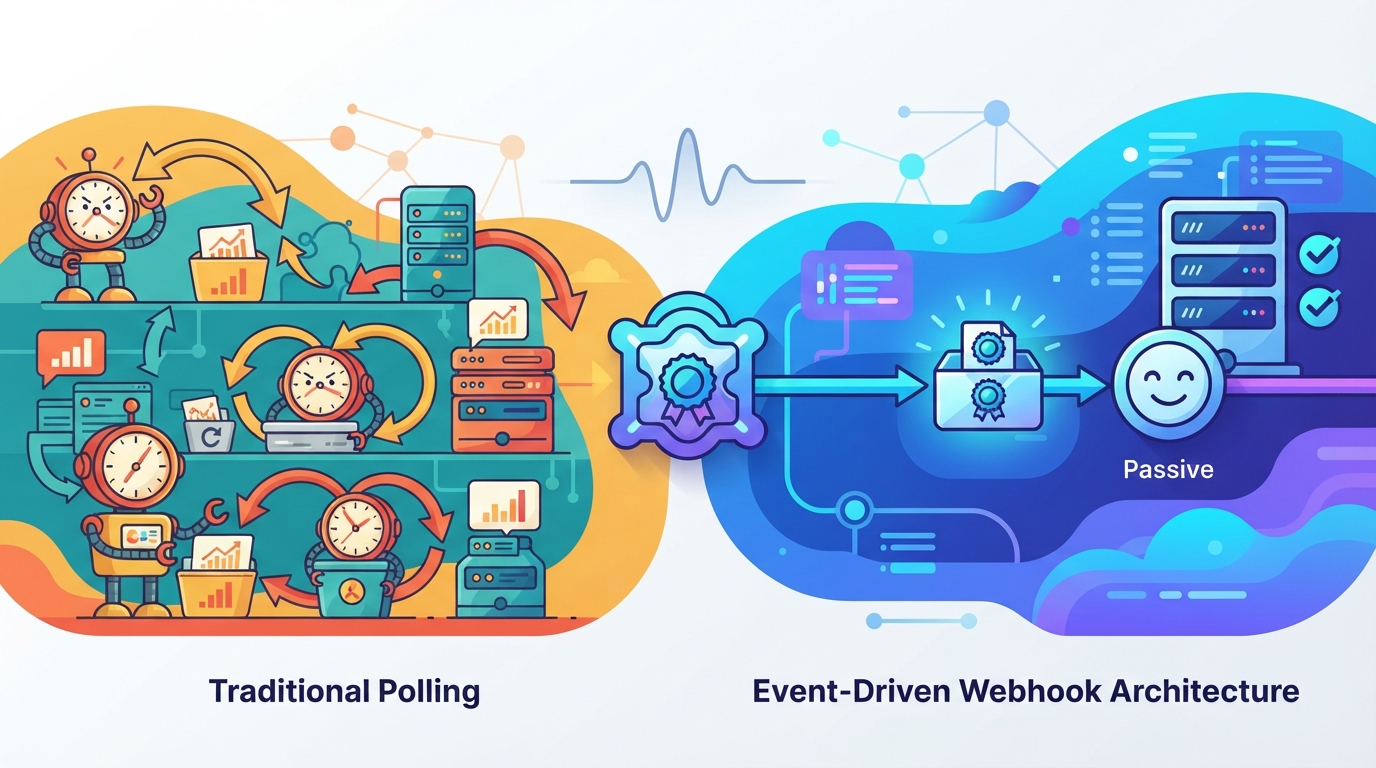
That failure forced me to dismantle our polling architecture and rethink how our system consumes asynchronous events. Relying on continuous polling loops for heavy synthetic market research pipelines creates unnecessary infrastructure strain and hides downstream latency, forcing teams to adopt event-driven webhook architectures that deliver signed payloads directly to receiving endpoints once a synthetic dataset finishes processing.
To solve this dependency, our pipeline now integrates directly with MoeVox, a research data platform designed for content creators who need empirical data and statistics to support SEO and GEO content. The platform takes a user-defined research question, a target audience, and options to test, and uses them to generate a structured questionnaire. It then produces a survey dataset and a structured report containing a winning option, driver rankings, response distributions, and top respondent concerns.
To generate this data, MoeVox runs the questionnaire against a simulated population model built from 100,000 real U.S. demographic records drawn from the U.S. Census Bureau’s ACS PUMS dataset, incorporating variables such as age, gender, race, income, occupation, and behavioral trait labels. Users can access the platform via a web application, credits-based pricing tiers, a REST API, or an AI prompt template.
When a synthetic survey dataset finishes processing, the platform dispatches an event notification directly to our registered endpoint, eliminating the need for constant status checks.
Why Polling Loops Fail Heavy Compute Workloads
Active polling loops waste compute resources and introduce arbitrary delays between dataset completion and downstream content ingestion. When a script makes repeated HTTP requests to check whether a heavy compute job has finished rendering, it burns API rate limits and saturates network bandwidth with redundant status inquiries.
Most developers default to REST APIs because they are straightforward and use standard HTTP methods they already know. According to Postman's 2025 State of API report on popular APIs, REST APIs represent the default choice for 93% of all developers. While this familiarity makes REST endpoints easy to set up for simple CRUD operations, forcing them to act as asynchronous status checkers for heavy computational tasks creates significant bottlenecks.
During our initial implementation, our polling script executed checks against the API every sixty seconds. When a synthetic population model took longer than expected to compile its response distributions, the script continued hammering the endpoint, consuming database connections and risking rate limit blocks.
This approach also introduces unpredictable latency into the publishing workflow. If a dataset finishes rendering ten seconds after a polling check completes, the system waits for the full duration of the next polling interval before noticing the update.
That delay compounds across multiple automated content pipelines, pushing back chart generation and article publishing times. Shifting from an active polling model to a passive notification model removes this polling overhead entirely, transferring the responsibility of state tracking from the client application to the server.
Measuring Latency and Resource Consumption
Active polling and passive webhook event notifications handle network overhead and CPU utilization in fundamentally different ways. Polling requires the consumer application to maintain persistent worker threads or scheduled cron jobs that constantly dispatch HTTP GET requests, regardless of whether new data exists.
Each request consumes local CPU cycles, opens TCP connections, and forces the upstream server to query its database for job statuses. When scaling an automated content platform across dozens of concurrent research topics, these polling threads saturate local memory and deplete available socket descriptors.
Webhook event notifications invert this resource consumption pattern. Instead of forcing the client to ask if work is done, the server holds the state internally and pushes a payload to a designated HTTP endpoint the exact millisecond processing finishes.
This mechanism mirrors how modern data notification pipelines operate across enterprise software ecosystems. According to Similarweb API documentation regarding data notifications via webhooks, daily data release subscriptions deliver metrics within 72 hours after the end of that date in the EST time zone, pushing updates directly to subscribers rather than requiring them to repeatedly query historical logs.
By eliminating empty polling requests, our infrastructure resources dropped significantly. Our application servers no longer allocate CPU time to repetitive status checks, and our network interfaces remain quiet until an actual dataset delivery event arrives.
This passive event-driven design ensures that our ingestion workers only spin up when payload data is guaranteed to be waiting in the request body.
Securing Payloads and Managing Delivery Failures
Shifting from polling scripts to webhook endpoints introduces new security and reliability challenges that require strict cryptographic signature verification and idempotent endpoint design. Because a webhook receiver exposes a public HTTP route to accept incoming traffic from external servers, any malicious actor who discovers the endpoint URL can flood it with forged payloads.
Securing these integrations requires validating incoming requests using cryptographic signatures, such as HMAC-SHA256 headers, to confirm that every payload originates from the legitimate research platform. Without this validation layer, an automated pipeline remains vulnerable to unauthorized data injections that can corrupt downstream article databases.
Network drops and server timeouts present another operational risk during massive analytical batch notifications. If a receiving endpoint experiences a brief network interruption or returns an unhandled error code while processing a large survey dataset, the event dispatcher must handle the failure gracefully.
According to Twilio documentation, the timeout for any individual webhook request is 15 seconds and missed connections are retried 5 times. If a listener is slow or encounters a bottleneck while parsing a massive demographic dataset, the communication provider drops the connection.
This strict timeout window means backend logic must execute or queue incoming payloads almost instantly to avoid delivery failures. To prevent duplicate retry attempts from creating duplicate records in our content generation pipeline, our ingestion endpoint relies on unique dataset identifiers to ensure idempotent processing, safely discarding repeated event notifications without duplicating our downstream analytical tables.
Comparing Legacy Feedback Webhooks to Analytical Batch Systems
Legacy feedback webhooks differ fundamentally from the heavy analytical batch notification systems required for synthetic market research pipelines. Traditional webhooks were designed for lightweight, real-time user interaction events, such as a user clicking a button, a form submission, or a simple transactional status update.
These legacy implementations typically transmit small JSON payloads containing a few string variables and status flags, requiring minimal parsing logic on the receiving end. In contrast, synthetic market research notifications must handle complex, multi-layered analytical datasets containing thousands of demographic variables, response distributions, driver rankings, and respondent concerns.
This data density changes the demands placed on the receiving endpoint. When an analytical batch notification triggers, the incoming payload is often orders of magnitude larger than a standard user event webhook.
If an engineering team attempts to parse these massive datasets synchronously inside the incoming HTTP request handler, the script frequently exceeds the 15-second communication timeout limit, triggering unnecessary retries from the upstream server.
Building a robust ingestion layer for analytical batch data requires decoupling the webhook listener from the heavy processing logic. Instead of parsing the survey dataset inside the HTTP request thread, the endpoint must instantly capture the payload, push it into an internal message queue, and return an immediate HTTP 200 acknowledgment to the sender.
This asynchronous separation protects the pipeline from timeout failures, ensuring that massive research datasets are ingested reliably without dropping connection handles during peak generation hours.
Comparing Integration Approaches for Synthetic Datasets
Connecting an automated pipeline to an external data provider requires choosing among custom REST wrappers, message queues, and direct webhook endpoints. Custom REST wrappers require writing scheduled scripts that query endpoints on a recurring timer. While this approach keeps the client architecture simple, it forces the system to repeatedly check for data that may not be ready.
Message queues offer a more resilient alternative by decoupling the ingestion listener from downstream parsing tasks. When an incoming notification arrives, the webhook endpoint captures the payload and drops it into a queue, protecting the system from timeout errors during heavy data parsing.
Direct webhook endpoints eliminate the middleman entirely, pushing completed survey datasets straight to the application route as soon as generation finishes.
When configuring our pipeline to ingest large demographic datasets, we abandoned custom REST wrappers because the maintenance overhead of managing retry loops and rate limits outweighed their simplicity.
Using message queues alongside direct webhook endpoints allowed our system to absorb traffic spikes without dropping incoming payloads or crashing our database workers.
Architectural Decision Matrix for Content Research
Deciding between webhooks, polling, and hybrid pipelines depends on the volume and predictability of your compute workloads. Polling remains viable only for low-frequency tasks where missing an update by a few minutes carries no operational penalty.
For high-throughput automated content workflows that ingest heavy research datasets, synthetic audience research platforms introduce unacceptable delays and burns valuable rate limits on empty checks when relying solely on active status polling.
Webhook architectures solve this bottleneck by ensuring that data delivery is event-driven and instantaneous. However, webhooks demand robust server infrastructure capable of handling sudden bursts of incoming traffic without returning unhandled error codes.
Hybrid pipelines combine the reliability of message queues with the real-time speed of webhooks, creating a fault-tolerant ingestion layer that handles massive analytical batch outputs smoothly.
When evaluating these architectures for our own publishing schedule, we found that direct webhooks backed by an asynchronous queue provided the only sustainable path for processing continuous streams of synthetic market research without manual oversight.
Implementation Blueprint and Final Verdict
Transitioning an automated content pipeline from polling loops to an event-driven webhook architecture requires a deliberate, step-by-step implementation plan.
First, configure a dedicated, publicly accessible HTTP endpoint secured by cryptographic signature verification to reject unauthorized payload injections.
Second, decouple the HTTP listener from your heavy processing logic by routing incoming payloads directly into an internal message queue, ensuring your server responds with an immediate success code before hitting the 15-second communication timeout threshold.
Third, implement idempotent processing rules using unique dataset identifiers to safely discard duplicate delivery retries without corrupting downstream tables.
Finally, structure your ingestion workers to parse demographic response distributions, driver rankings, and respondent concerns only after the payload is safely stored in your local queue.
By enforcing this design pattern, our pipeline stopped missing completed runs and eliminated wasted compute cycles entirely.
If your automated publishing schedule relies on heavy synthetic research datasets, ask yourself this: how many publishing cycles did your polling scripts miss last week while waiting for an API response that had already finished hours earlier?