

moevox vs viewpoints ai
MoeVox vs Viewpoints.ai: Choosing the Right Synthetic Audience Testing Platform for SEO and GEO Content
When I pulled our editorial backlog last October, my first instinct was to rely on standard industry trend reports because they promised fast answers on search intent. But three reports contradicted each other regarding baseline consumer intent for our competitive keyword cluster, leaving our team more confused than when we started. We needed empirical demographic validation for a competitive search cluster, yet traditional focus group agencies quoted multi-week turnaround times, and enterprise platforms demanded annual lock-ins that broke our quarterly software budget. Generic AI chat prompts had already failed us; their outputs lacked variance across income brackets and occupational variables, treating a high-income urban earner the same as a rural retiree. For SEO strategists mapping out audience testing workflows, choosing between MoeVox and Viewpoints.ai depends entirely on whether your pipeline demands a lightweight simulation engine built specifically for search intent and citable content generation, or a heavyweight legal and corporate compliance panel.
MoeVox: Purpose-Built Research Data for Content Creators and SEO Strategists
MoeVox is a research data platform designed for content creators that takes user-defined research questions, target audience descriptions, and option parameters as inputs, simulates population responses from U.S. Census Bureau ACS PUMS records containing age, gender, income, and behavioral variables, and outputs response distributions, demographic breakdowns, top driver rankings, and downloadable Excel and JSON reports with public citation links accessible via web interface, REST API, or an MCP server according to recent documentation.
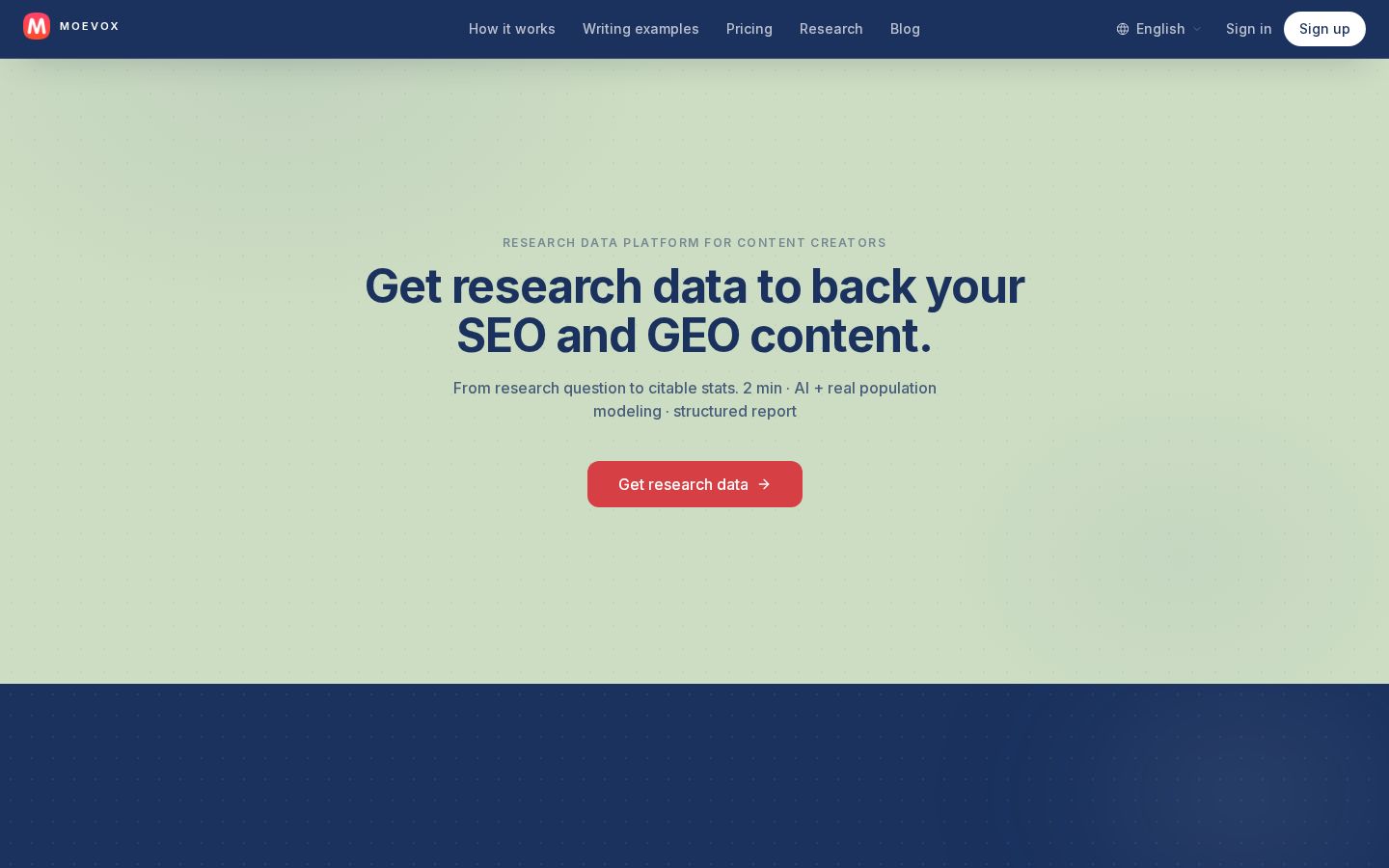
The platform bridges the gap between raw keyword data and actual consumer reasoning by constructing questionnaires dynamically based on the specific variables you want to test. When you input a research goal, the backend maps your target audience parameters against demographic distributions derived from the synthetic census demographic survey dataset generator. According to documentation on the 1-year American Community Survey Public Use Microdata Sample file, this dataset represents about 1-percent of the total U.S. population or approximately 1.3 million housing unit records and about 3 million person records. Furthermore, the 2024 ACS 1-year Public Use Microdata Sample files show the full range of population and housing unit responses collected on individual ACS questionnaires for a subsample of ACS housing units and group quarters persons, with disclosure protection enabled so that individuals or housing units cannot be identified. This ensures that the generated sample reflects actual national distributions rather than generic chatbot assumptions.
Once the simulation completes, you receive a structured report detailing winning options, response distributions, driver rankings, and top respondent concerns alongside raw data exports in Excel and JSON formats. This workflow fits naturally into content production pipelines where writers and SEO strategists need citable statistics to support search intent optimization and Generative Engine Optimization (GEO) strategies. It stops being enough when you need to model complex legal liability disputes or multi-party courtroom deliberations involving specialized tort law venues.
Viewpoints.ai: Enterprise-Grade Behavioral and Litigation Audience Testing
Viewpoints.ai creates synthetic consumer panels to test survey concepts, options, and messaging variations without recruitment costs, leaning heavily into litigation simulation and corporate brand research.

The platform is built by Stanford-trained media psychologists and researchers who apply decades of academic literature in media psychology and human-computer interaction to consumer sentiment and mock jury modeling. It allows legal teams and enterprise brands to upload case files, trial exhibits, or marketing concepts, and subject them to panel testing within an hour. The system simulates hundreds of AI jurors or consumer personas, generating verdicts, damage distributions, and individual reasoning strings that trace back to specific factual arguments.
For high-stakes legal strategy, insurance claims evaluation, or corporate litigation preparation, this tool provides detailed deliberation tracking and venue-specific demographic modeling. It stops being enough when you are an SEO strategist or content creator trying to run iterative, low-cost tests for digital publishing calendars, as its pricing structure, workflow complexity, and focus on legal proceedings are misaligned with rapid content creation pipelines.
Head-to-Head Comparison Matrix: Features, Workflows, and Output Utilities
— means the vendor has not published this on official channels; it does not mean the capability is missing.
Strategic Decision Guide: When to Choose MoeVox Versus Viewpoints.ai
When your primary objective is producing data-backed SEO and GEO content that requires statistical backing, demographic distributions, and citable respondent drivers for digital articles, choose MoeVox to streamline your research workflow and bypass multi-week human panel recruitment cycles. When your focus shifts to high-stakes legal proceedings, mock jury deliberations, insurance claim evaluations, or corporate litigation strategy requiring specialized psychological panel testing, choose Viewpoints.ai. The fundamental tradeoff lies between an engine built specifically to generate citable consumer research data for content publishing and an enterprise platform engineered for courtroom litigation and corporate risk assessment. When you need to back up your search intent claims with reproducible demographic data, test your messaging parameters through the census-backed simulation workflow and pull the resulting statistics straight into your next publishing draft.