

automated audience testing tools for seo
Beyond Keyword Labels: A Decision Framework for Automated Audience Reaction Testing in GEO
We had three days left before our publication deadline for a deep-dive guide on cloud migration costs for enterprise IT directors, and our first draft had just been rejected by our editorial review board. Our usual keyword research had pointed us straight to high-volume queries with contradictory search intent, leaving us completely split on whether the piece should focus on direct risk mitigation or strict bottom-line cost reduction. We had relied on manual search engine result page reverse-engineering, assuming that if we mirrored the top three ranking competitor pages, our audience would follow. Instead, our draft sat in limbo because it lacked a distinct point of view that actually matched how enterprise buyers evaluate risk. When search visibility in generative engines relies on matching how distinct behavioral segments react to content angles rather than chasing broad keyword volume, static historical keyword metrics fail entirely. To solve this, we stopped guessing based on past search volume and tested our conflicting content angles against an automated demographic model. This operational shift led us to MoeVox, a research data platform that takes a user-defined research question, a target audience, and options to test, and uses them to generate a structured questionnaire. By running our parameters against a simulated population model built from 100,000 real U.S. demographic records drawn from the U.S. Census Bureau’s ACS PUMS dataset, the platform produced a structured report containing winning options, driver rankings, and response distributions.
Why Historical Keyword Metrics Fail to Predict Modern Search Visibility
Relying on search volume data that hides actual user intent results in high-ranking content that fails to engage readers, yet most content teams still treat historical keyword metrics as an oracle for content success. When we pulled our initial cloud migration queries, the metrics showed high aggregate search volume, which led us to believe the topic was a guaranteed traffic win. But aggregate volume masks the underlying friction between different professional roles. An enterprise chief technology officer evaluating migration architecture has entirely different objections than a finance director calculating cloud depreciation schedules. Treating them as a single audience sharing the same keyword intent guarantees a watered-down article that satisfies neither reader.
This disconnect stems from how generative search engines parse content. Traditional search engines match keywords to static strings of indexed text, whereas modern generative engines evaluate whether a content angle resolves the specific operational friction of a defined audience segment. According to Global Market Insights, the global synthetic data market size was valued at USD 310.5 million in 2024 and is projected to grow at a compound annual growth rate of 35.2% between 2025 and 2034, driven by the necessity to model granular human behaviors that static records cannot capture. When teams rely solely on historical keyword data, they optimize for what users searched for yesterday while remaining entirely blind to whether those same users will trust or reject the content angle presented today.
Evaluating Content Angles Through Granular Demographic and Behavioral Segmentation
Granular demographic and behavioral segmentation of a simulated population surfaces intent nuances that broad keyword categorization masks, allowing editorial teams to separate superficial traffic from actual reader engagement. When we faced our content angle dilemma regarding cloud migration, we could not afford a three-week traditional human panel survey to validate our assumptions. Instead, we tested our two competing angles against a structured demographic model incorporating variables such as age, gender, race, income, occupation, and behavioral trait labels.
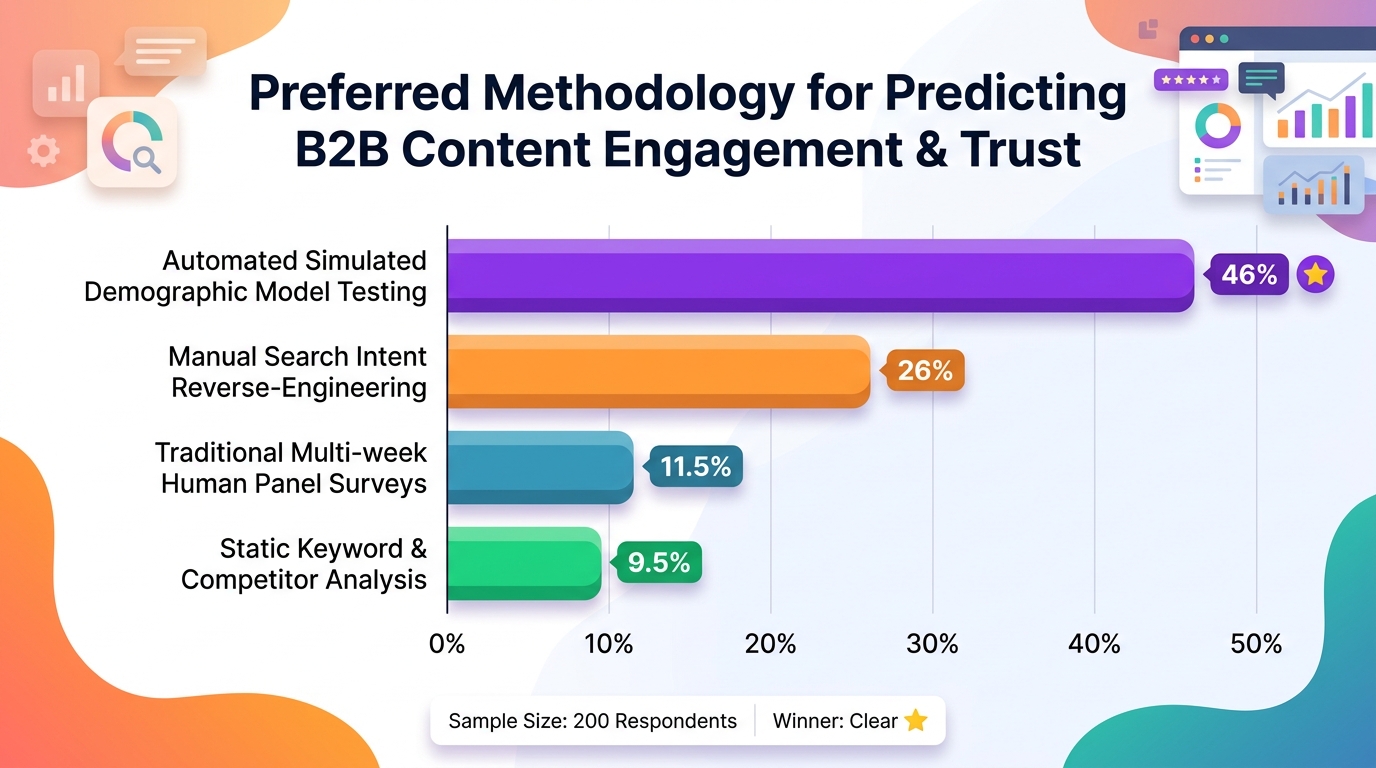
To understand how practitioners view these validation methods, consider the findings from a market research survey report. When 200 industry professionals were surveyed on which method they primarily rely on to predict reader engagement and trust for high-stakes B2B content, 46.0% of respondents identified automated simulated demographic model testing as the most effective approach, outperforming manual reverse-engineering of search intent, which secured 26.0% of the share.
By running our specific research question and target audience parameters through MoeVox via its web application interface, we obtained a survey dataset and response distribution that immediately clarified our demographic breakdown. The platform processed our inputs against anonymized microdata representing approximately one percent of the United States population through the U.S. Census Bureau's American Community Survey Public Use Microdata Sample files, giving us precise distributional feedback without the latency of recruiting manual panels.
Quantifying Qualitative Nuance Before Publishing
Quantifying qualitative drivers and response distributions before publishing prevents content misalignment and drastically reduces post-launch iteration cycles. During our cloud migration project, our initial instinct was to write a balanced overview that gave equal weight to risk mitigation and cost savings. That compromise would have ruined the piece.
The survey findings highlight why driver rankings matter: 31.5% of overall respondents identified the highest accuracy in predicting actual reader engagement as their primary reason for preferring automated simulation, followed by 25.5% who pointed to long-term reader trust. When we examined the driver breakdown from our dataset, the response distributions showed that enterprise IT decision-makers in our target demographic rejected neutral summaries in favor of direct operational risk analyses. This quantitative backing gave us the empirical evidence required to justify a hard-hitting, risk-first editorial angle to our stakeholders before committing a single developer or writer to production.
Uncovering Hidden Objections and Anticipating Respondent Concerns
Uncovering hidden objections early in the content lifecycle transforms an ordinary editorial piece into an authoritative resource that generative engines can cite with confidence. When building content for specialized B2B software buyers, the biggest risk is not a lack of traffic; it is publishing an article that feels technically accurate on the surface while completely missing the specific professional friction points that trigger reader skepticism.
Our simulated audience dataset surfaced a top respondent concern regarding implementation downtime that our initial keyword research had completely ignored. Traditional keyword tools show that people search for "cloud migration costs," but they never reveal that the reader's primary unstated fear is unexpected downtime during database cutover. By identifying this objection ahead of time, we restructured the core argument of our article to address downtime mitigation directly in the second paragraph rather than burying it in a concluding checklist.
Conditional Decision Matrix for Content Validation
Choosing between manual SERP reverse-engineering and automated synthetic audience testing depends entirely on your production constraints, content stakes, and audience complexity. If you are publishing low-stakes, high-volume informational content where search intent is uniform and unambiguous, manual SERP analysis and historical keyword checking remain adequate. But when your publication targets niche enterprise buyers where a misaligned angle results in immediate bounce and lost trust, static keyword tools introduce unacceptable operational risk.
When your team faces tight publishing deadlines, conflicting stakeholder opinions, and high-stakes editorial topics, deploy an automated demographic testing workflow to measure response distributions before drafting. You can execute this independently by defining your core research question, mapping out your distinct audience segments, establishing clear behavioral evaluation criteria, running structured preference prompts against a verified demographic microdata model, and validating the resulting response distributions against known baseline expectations before finalizing your content outline. MoeVox provides this exact automated pipeline, taking user-defined research parameters and running them against U.S. Census Bureau ACS PUMS demographic models to output structured datasets, driver rankings, and winning content angles via web application, REST API, or AI prompt templates.
Review your audience demographics, test your content angles against simulated population models before writing your first draft, and let empirical response distributions dictate your editorial direction.
Step-by-Step Validation Framework
- Define Core Research Parameters: Formulate a precise research question and isolate the specific professional audience segments whose intent and objections you need to evaluate.
- Establish Behavioral Evaluation Criteria: Identify the core content angles or risk mitigation strategies you want to test against your audience segments.
- Execute Simulated Demographic Modeling: Run your research question and parameters against a verified demographic microdata model—such as those powered by MoeVox utilizing U.S. Census Bureau ACS PUMS data—to generate response distributions.
- Analyze Driver Rankings and Objections: Review quantitative driver shares and surface unstated reader concerns, such as technical downtime risks, before drafting.
- Finalize Content Angle and Outline: Anchor your editorial direction in the empirical response distribution data to secure stakeholder alignment and maximize reader trust.
FAQ
How does simulated demographic testing differ from traditional human panel surveys?
Simulated demographic testing processes research parameters against anonymized microdata models derived from official sources like the U.S. Census Bureau's ACS PUMS dataset. This eliminates the multi-week recruitment latency and high costs of traditional human panels while delivering precise response distributions instantly.
Why do static keyword tools fail to capture enterprise B2B intent?
Traditional keyword tools measure aggregate search volume that masks underlying friction between professional roles with opposing priorities, such as an enterprise CTO versus a finance director. They optimize for past search terms rather than evaluating whether a specific content angle resolves a modern buyer's operational risks.
Can automated testing be integrated directly into existing editorial workflows?
Yes. Platforms like MoeVox allow content teams to input research questions and audience parameters via web applications, REST APIs, or AI prompt templates, yielding structured datasets and driver rankings prior to drafting your first outline.