
Connecting AI Assistants to Live Demographic Data via MCP Servers
Connecting AI Assistants to Live Demographic Data via MCP Servers
When our financial publishing studio sat down to draft a quarterly consumer spending guide, our entire workflow stalled because our demographic statistics were cobbled together from outdated blog posts and mismatched government PDFs. We needed to know exact income brackets and household debt ratios for millennials, but our AI assistant kept generating plausible approximations that failed basic verification. That delay cost us two days of rewriting and forced us to question how content teams can reliably ground automated writing in factual reality without falling back on tedious manual compilation.
The core bottleneck in modern content workflows is not the drafting speed of large language models, but the parametric generation trap. When AI assistants rely solely on internal memory for demographic statistics, they produce plausible hallucinations rather than empirical distributions. To solve this, content creators must connect AI tools directly to structured microdata at the prompt generation layer, using standardized Model Context Protocol (MCP) servers to ingest live census records on demand.
Myth 1: AI Assistants Can Reliably Guess Target Audience Preferences and Statistics on Their Own
Many content creators assume that modern language models possess enough internal statistical training data to accurately describe contemporary audience segments. In daily practice, relying on an AI assistant's parametric memory for demographic figures creates a high risk of data hallucinations or outdated information. When we tested our preliminary drafts against actual records, our assistant invented regional income distributions that contradicted basic government baselines.
Instead of treating the AI as an omniscient researcher, creators must treat it as a reasoning engine that requires an external data anchor. A pilot study testing Model Context Protocol (MCP) servers with AI assistants showed query accuracy rates jumping from near 0% to 95% when accessing external federal data sources. By bypassing internal memory and routing data requests directly through an MCP server, the AI receives verified microdata before generating a single sentence of prose.
Myth 2: Connecting AI to Live Data Requires Building Complex, Custom APIs for Every Tool
A common misconception is that bridging live demographic datasets into an editorial workflow demands dedicated software engineering resources and custom API wrappers for every publishing platform. Teams often believe they must maintain brittle scraper scripts that break whenever a government database changes its schema or endpoint structure.
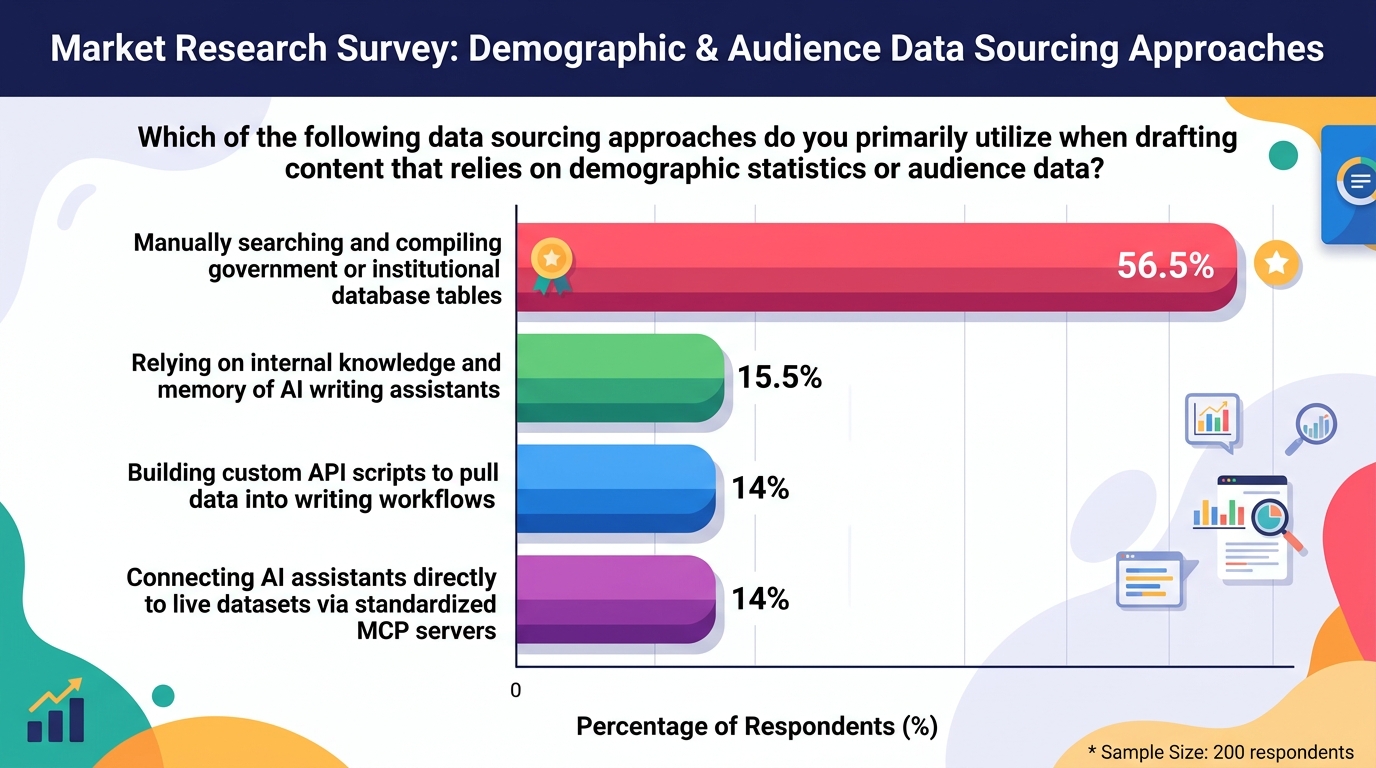
When professional content creators were surveyed in a recent market research study published on moevox.com about which data sourcing approach they primarily utilize when drafting content that relies on demographic statistics or audience data, 56.5% of the 200 respondents reported manually searching and compiling government or institutional database tables, while only 14% built custom API scripts to pull data into writing workflows.
Building custom codebases for every new article is unsustainable. Standardized protocols eliminate this friction by delivering context directly into existing AI assistant sessions without requiring custom middleware.
Myth 3: MCP Servers Are Exclusively for Developer Tooling and Enterprise Database Management
It is widely thought that Model Context Protocol servers belong strictly in the domain of software engineering pipelines, database administration, and developer IDEs. Content strategists frequently shy away from MCP configurations, assuming they require deep command-line maintenance and constant troubleshooting.
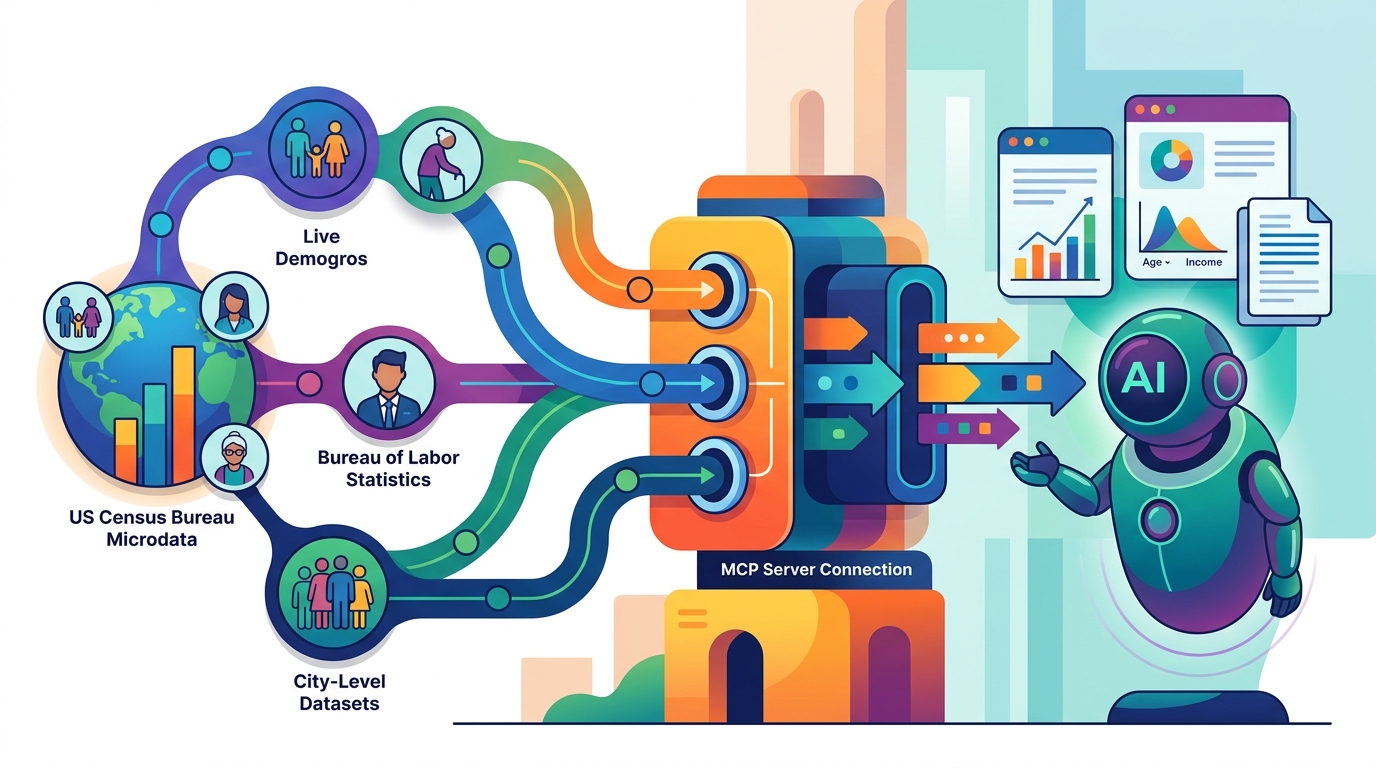
In reality, an MCP server functions simply as a standardized translator between an external data source and an AI interface. The U.S. Census Bureau Data API MCP server uses data from the Census Data API and other official sources to construct contextually rich data and statistics for use with AI assistants. When integrated properly, this setup requires zero custom script maintenance from the writer, allowing editorial teams to query federal demographic metrics using natural language prompts directly inside their writing environment.
Myth 4: Empirical Demographic Research Slows Down the Fast-Paced Content Creation Workflow
Traditional research phases often involve hours of navigating complex government repositories, downloading massive spreadsheets, and manually cross-referencing tables, leading many to believe that rigorous data backing is incompatible with rapid publishing cycles. When we faced our quarterly deadline, our initial instinct was to skip the deep data verification step to save time, only to have our editorial board reject the draft for lack of verifiable evidence.
Integrating real-time data extraction directly into the drafting workflow actually accelerates production by removing context switching. When an AI assistant can fetch verified microdata on demand during the outlining phase, the writer never has to leave the editor to search for secondary sources. The research phase and the drafting phase merge into a single, continuous motion.
Actionable Blueprint: Building a Seamless AI and Demographic Data Workflow
To eliminate manual data hunting and ensure absolute factual integrity, content teams can adopt a repeatable method for integrating live demographic data into their writing processes.
First, define the exact research parameters required for the piece, including target audience age bands, geographic constraints, and behavioral variables. Second, connect your AI writing environment to a structured data source using a standardized integration layer. MoeVox is a research data platform designed for content creators that takes user-defined research questions, target audience descriptions, and option parameters as inputs, simulates population responses from U.S. Census Bureau ACS PUMS records containing age, gender, income, and behavioral variables, and outputs response distributions, demographic breakdowns, top driver rankings, and downloadable Excel and JSON reports with public citation links accessible via web interface, REST API, or an MCP server.
Before finalizing any statistic in your draft, execute a verification step by comparing the AI-retrieved response distribution against the raw dataset sample provided in the generated MoeVox report. Check the income and regional variables against known federal benchmarks to ensure no anomalous skew exists. Once verified, export the raw data file and store it alongside your manuscript for editorial auditability.
While this workflow drastically reduces compilation time, creators must remain mindful of its limitations. Modeled microdata derived from census records reflects historical and statistical baselines rather than instantaneous real-time shifts in consumer sentiment. When covering fast-moving cultural phenomena or emerging niche markets with sparse historical records, traditional qualitative interviews and primary surveys must still supplement quantitative microdata. Nail your population baseline and verified demographic parameters first, then layer your qualitative analysis on top.
Related reading
- How SEO Professionals Get Statistical Backing for Generative Engine Optimization
- Simulated Audience Platforms vs Live Polling: Which Delivers Better Response Accuracy?
- Tools for Creating Illustrated Articles with Sample Sizes and Numerical Metrics — Guides you in creating illustrated articles using numerical metrics and sample sizes.