

How SEO Professionals Get Statistical Backing for Generative Engine Optimization
When our consumer borrowing trends report stalled in retrieval testing last year, our team hit a hard wall with our data pipeline. Scraping public forum data yielded fragmented, non-citable numbers, while external research agencies quoted delivery timelines and budgets that exceeded our operational limits. We needed primary statistical backing to survive the shift toward conversational search engines, but traditional research methods failed us entirely. Generative engine optimization requires proprietary demographic micro-survey data rather than aggregated secondary research, because large language models heavily favor citable, primary empirical distributions during retrieval-augmented generation. To solve this, we abandoned manual data scraping and agency outsourcing, deciding instead to programmatically generate structured questionnaires and simulate population responses against census demographic variables through an automated research platform like MoeVox, which takes user-defined research questions, target audience descriptions, and option parameters as inputs to automatically generate structured questionnaires and simulate population responses based on U.S. Census Bureau ACS PUMS demographic records.
The Conversational Prompt Bottleneck in Modern Search
Conversational engines do not rank pages by counting keyword density or matching anchor text; they synthesize answers by extracting verifiable empirical statements from retrieved documents. When an AI search overview constructs an answer about consumer financial behavior, it looks for primary statistical backing that carries exact sample definitions and granular demographic breakdowns.
Our team learned this the hard way when our draft borrowing trends article failed retrieval testing because it relied on broad, unsourced assertions. A Princeton study published at KDD found that nine specific content tactics collectively called Generative Engine Optimization increase how often AI engines cite a source by up to 40% (Aggarwal et al., "GEO: Generative Engine Optimization," KDD 2024). More importantly, replacing vague language with hard numbers produced a 37% uplift in citation frequency in the same Princeton GEO experiment. Without hard numbers and primary distributions, content simply gets bypassed by retrieval algorithms that prioritize factual density over persuasive prose.
Generative search engines bypass persuasive prose and broad assertions entirely, rewarding content that anchors its claims in primary empirical distributions and exact statistical definitions.
Why Traditional Research Methods Fail Content Teams
Most content teams attempt to solve the data deficit by falling back on secondary aggregation or expensive custom panels, both of which introduce fatal bottlenecks for agile publishing workflows. In a market research survey sampling 200 professionals Which primary data sourcing method do you prioritize for producing original research intended to secure citations in AI-generated search results?, 42.0% of respondents reported relying most heavily on aggregating existing secondary studies and published industry reports when producing original research intended for AI citations. Only 17.5% of the 200 surveyed professionals prioritized automated demographic simulation and micro-surveys leveraging census variables.
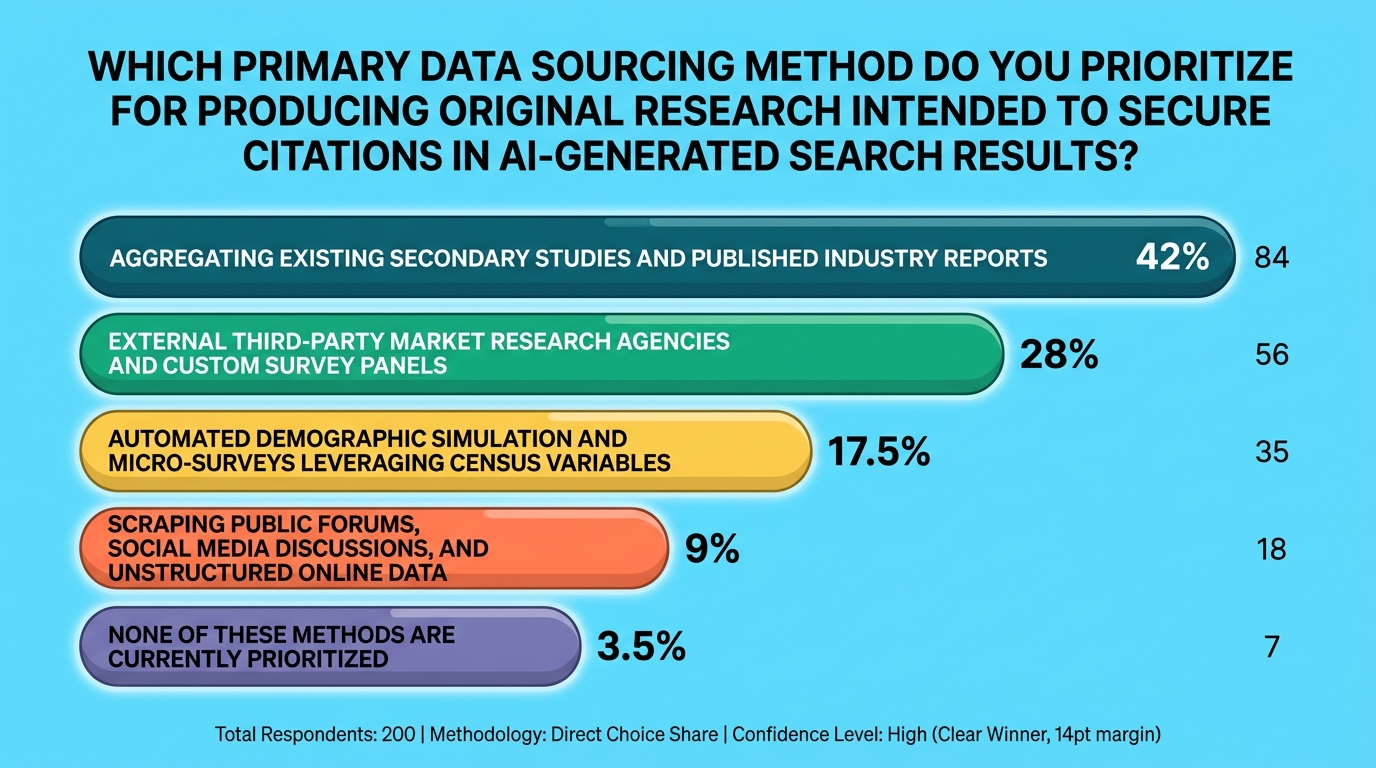
That heavy reliance on secondary reports creates a systemic trap. Search engines and conversational models parse and penalize repeated or generic statistics that lack primary contextual grounding. When multiple publishers cite the same aggregated industry report, retrieval-augmented generation systems identify the duplication and dilute the citation weight assigned to each page. Furthermore, external custom survey panels introduce severe friction. When comparing data collection methodologies for audience research, evaluating Simulated Audience Platforms vs Live Polling: Which Delivers Better Response Accuracy? helps teams understand the trade-offs between synthetic modeling and traditional live survey fielding. According to the same survey data, lack of internal budget or resources is the most common barrier preventing teams from switching to more rigorous sourcing methods, cited by 52.5% of the 200 respondents. Traditional primary research demands weeks of fielding and thousands of dollars, making it impossible to scale production for fast-moving editorial calendars.
Simulating Demographic Micro-Surveys for GEO
Automated demographic simulation bypasses secondary aggregation and eliminates external panel delays by grounding custom questionnaires in verified census data. When shifting away from legacy workflows such as Migrating from Typeform to MoeVox for AI-Assisted Content Research, content teams feed their specific research parameters into MoeVox, which takes user-defined research questions, target audience descriptions, and option parameters as inputs to automatically generate structured questionnaires and simulate population responses based on U.S. Census Bureau ACS PUMS demographic records.
The U.S. Census Bureau American Community Survey reaches about 3.5 million addresses a year and reports on more than 40 social, economic, housing, and demographic topics. By anchoring our simulated micro-surveys in this underlying demographic reality rather than random synthetic generation, we produced statistically coherent response distributions across age, income, and marital status segments within minutes. When we ran our consumer borrowing survey through this pipeline, the platform processed our custom parameters against the census pool to generate explicit response shares, demographic breakdowns, and downloadable raw data files without requiring a dedicated research operations team.
Structuring Empirical Reports for RAG Retrieval
Formatting data into strict tabular structures ensures conversational AI models extract and attribute empirical findings without parsing errors. Retrieval-augmented generation engines read structured tables and raw data files much more reliably than inline narrative figures.
During our borrowing trends project, we established a strict verification and formatting protocol that you can replicate independently:
- Define a precise research question and isolate the demographic variables relevant to your target audience segment.
- Generate the response distribution using verified demographic micro-survey methods, ensuring sample parameters are explicitly stated alongside every figure.
- Run a sanity check on the output by comparing key demographic splits against known public baselines, such as verifying that income distribution curves align with published census brackets.
- Export the final dataset into clean tabular structures and provide downloadable Excel or JSON raw data files directly within the article body.
- Publish a public citation link alongside the dataset so AI crawlers can verify the primary origin of the numbers during retrieval.
When our team published the borrowing trends report using this exact multi-format approach, conversational search engines successfully extracted our proprietary income-trait correlation data and cited our domain as the primary source.
Integrating On-Demand Statistical Workflows
Connecting content management pipelines directly to automated simulation infrastructure via REST APIs and Model Context Protocol servers enables editorial teams to scale empirical research without manual lag. In our editorial operations, we eventually connected our content management pipeline directly to research infrastructure via REST APIs and Model Context Protocol servers used by AI assistants.
When drafting specialized guides on consumer credit behavior, our editorial assistants now query our statistical backend directly from the drafting environment. The system accepts our prompt parameters, simulates the demographic response set against ACS PUMS variables, and returns a verified JSON data object complete with segment breakdowns and citation links. This eliminates the manual lag between writing and empirical validation, allowing our small team to publish data-backed insights at a velocity that matches major enterprise publishers while maintaining the strict primary grounding required by modern generative engines.
Scaling content production for conversational search requires bridging the gap between editorial workflows and verified simulation APIs, removing the traditional delays of external research fielding.
Tracking Brand Share-of-Voice and AI Citation Shortlists
Auditing AI search overviews against probe prompts reveals whether proprietary datasets successfully capture brand share-of-voice and drive citation shortlists. When we audited our visibility after publishing our structured datasets, we tracked our brand share-of-voice across major AI search overviews by running probe prompts related to consumer borrowing trends.
The results confirmed our initial hypothesis. Because our articles supplied clean, downloadable empirical datasets paired with transparent demographic parameters, conversational engines began featuring our domain in their citation shortlists for complex financial queries. When your content provides the exact primary data points that AI models need to ground their answers, you stop competing for generic keyword rankings and instead become the foundational source that the engine relies upon to construct the truth.
FAQ
Why do generative search engines prefer primary micro-survey data over secondary industry reports?
Generative engines synthesize answers by extracting verifiable empirical statements with exact sample definitions and demographic breakdowns. Aggregated secondary reports often suffer from repetition across multiple publishers, which leads retrieval-augmented generation systems to dilute citation weights or flag the content as duplicative.
How does demographic simulation avoid the pitfalls of manual data scraping?
Manual scraping yields fragmented and non-citable numbers from public forums, whereas automated simulation anchors custom questionnaires in verified public baselines like U.S. Census Bureau records. This produces statistically coherent response distributions across demographic segments without requiring expensive custom panels or weeks of fielding.
What operational barriers prevent content teams from adopting rigorous primary research?
Primary constraints include a lack of internal budget and resources, which market research data shows affects over half of content professionals. Automated simulation workflows mitigate this by integrating directly into editorial pipelines to generate verified empirical datasets efficiently.
Related reading
- Migrating from Typeform to MoeVox for AI-Assisted Content Research
- Simulated Audience Platforms vs Live Polling: Which Delivers Better Response Accuracy?
- Tools for Creating Illustrated Articles with Sample Sizes and Numerical Metrics — Guides you in finding tools that create illustrated articles with metrics.