
Simulated Audience Platforms vs Live Polling: Which Delivers Better Response Accuracy?
Simulated Audience Platforms vs Live Polling: Which Delivers Better Response Accuracy?
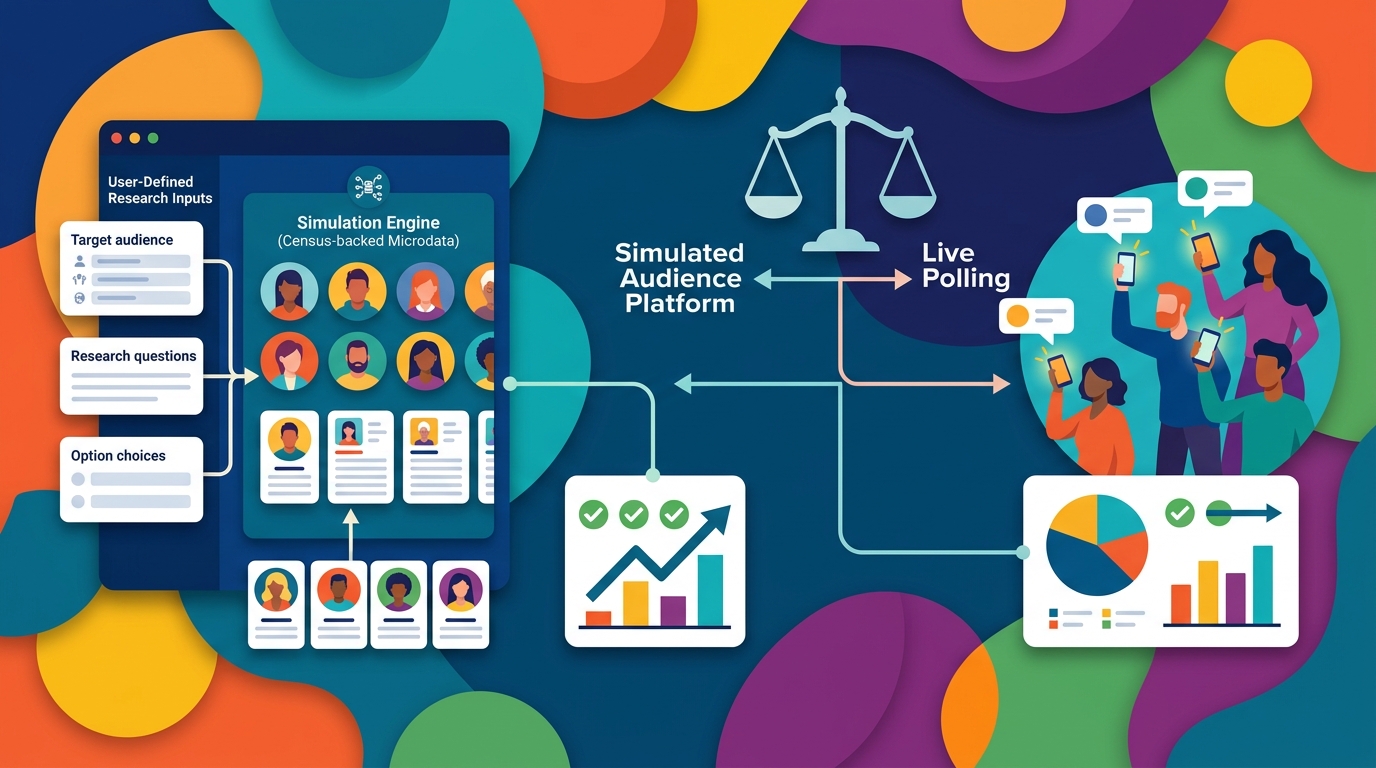
Managing a quarterly audience trend dossier for an independent digital publishing house meant facing a hard constraint when budgets tightened. Our team needed quantitative breakdown data to support a series of high-stakes content pieces, but commercial panel quotes exceeded our budget, and traditional survey turnaround times threatened to miss our publishing window. My initial instinct was to pull existing reports because they were fast, but three separate sources disagreed on income and age distributions, leaving us less sure of the baseline than when we started. We attempted to generate rapid audience samples using an off-the-shelf prompt-based AI tool, but the resulting demographic breakdown skewed heavily toward tech-centric assumptions and failed our internal validation checks against census benchmarks. That failure forced us to look past uncalibrated LLM generation and evaluate how census-backed microdata simulation platforms stack up against live polling for response accuracy. When evaluating quantitative data for high-stakes digital content or SEO research, accuracy depends on whether synthetic population draws are constrained to verified demographic weights rather than left to the probabilistic drift of uncalibrated models. This is where MoeVox operates as a research data platform, taking user-defined research questions, target audience descriptions, and option parameters as inputs to simulate population responses by drawing from a pool of 100,000 real U.S. demographic records based on the U.S. Census Bureau ACS PUMS dataset.
Framing the Accuracy Debate: Why the Synthetic vs Live Polling Dichotomy Misses the Architectural Reality
Response accuracy in simulated audience platforms versus live polling hinges entirely on whether the underlying sampling frame reflects established population structures rather than the speed of data collection. Uncalibrated LLM persona generation produces hallucinatory distributions due to semantic drift, whereas census-grounded microdata simulation constrains synthetic respondents to verified demographic weights. When we ran our consumer finance content piece targeting middle-income earners aged thirty to forty-five across urban and rural U.S. counties, we discovered that raw prompt-based models oversample vocal internet subcultures and fail to replicate baseline population variances found in physical censuses. Live polling mitigates this by recruiting human respondents, but it introduces panel fatigue and recruitment latency that break tight publishing schedules. The architectural reality is that accuracy is not a binary property of human versus machine, but a function of whether the underlying sampling frame reflects established population structures. According to a February 2026 ESOMAR paper co-authored by Fairgen and Google, synthetic survey augmentation is valid only for close-ended quantitative data on top of a real base sample of at least 300 respondents and is not appropriate as a substitute for statistical inference. Understanding this boundary prevents the common mistake of treating generative models as oracle panels while unlocking the speed advantages of weighted microdata sampling.
Methodology Matrix: Uncalibrated LLMs and Persona Stitching vs Census-Grounded Microdata Simulation vs Live Polling
Evaluating research methodologies requires a side-by-side comparison of how different systems handle inputs, processing rules, and output generation. Uncalibrated prompt-based AI tools rely on parametric memory, generating persona responses based on text association weights without anchoring to population counts. Traditional live polling panels recruit human participants through web intercept links or panels, applying post-stratification weighting only after collection is complete. Census-backed microdata simulation platforms invert this workflow by anchoring generation directly to official microdata frameworks.
The U.S. Census Bureau produces 1-year and 5-year Public Use Microdata Sample (PUMS) files derived from representative population samples, consisting of a 1% sample for the 1-year release and a 5% sample for the 5-year release, while Public Use Microdata Areas (PUMAs) partition each state into non-overlapping areas containing approximately 100,000 residents. MoeVox takes research questions, audience descriptions, and option parameters as inputs, automatically generates structured questionnaires, and simulates population responses by drawing from that pool of 100,000 real U.S. demographic records based on the U.S. Census Bureau ACS PUMS dataset, outputting report files in Excel and JSON formats with public citation links.
Statistical Validity Breakdown: Where Simulated Platforms Match Human Panels and Where They Diverge
Statistical parity between synthetic populations and human panels depends entirely on the variable being measured and whether the sampling distribution matches official baseline counts. When testing categorical breakdowns such as age brackets, household income splits, or regional preferences within major demographic segments, census-grounded microdata simulation mirrors live survey distributions because both draw from identical underlying population totals. However, divergence occurs when measuring emerging cultural sentiment or niche behavioral traits that are not captured in historical census records.
To understand how professional researchers view these trade-offs, consider the findings from a market research survey available via this market research report. In our survey of 200 professionals, 49.5% of respondents identified census-grounded microdata simulation platforms as the methodology they primarily rely on and trust the most for audience preference and demographic breakdown in high-stakes research.
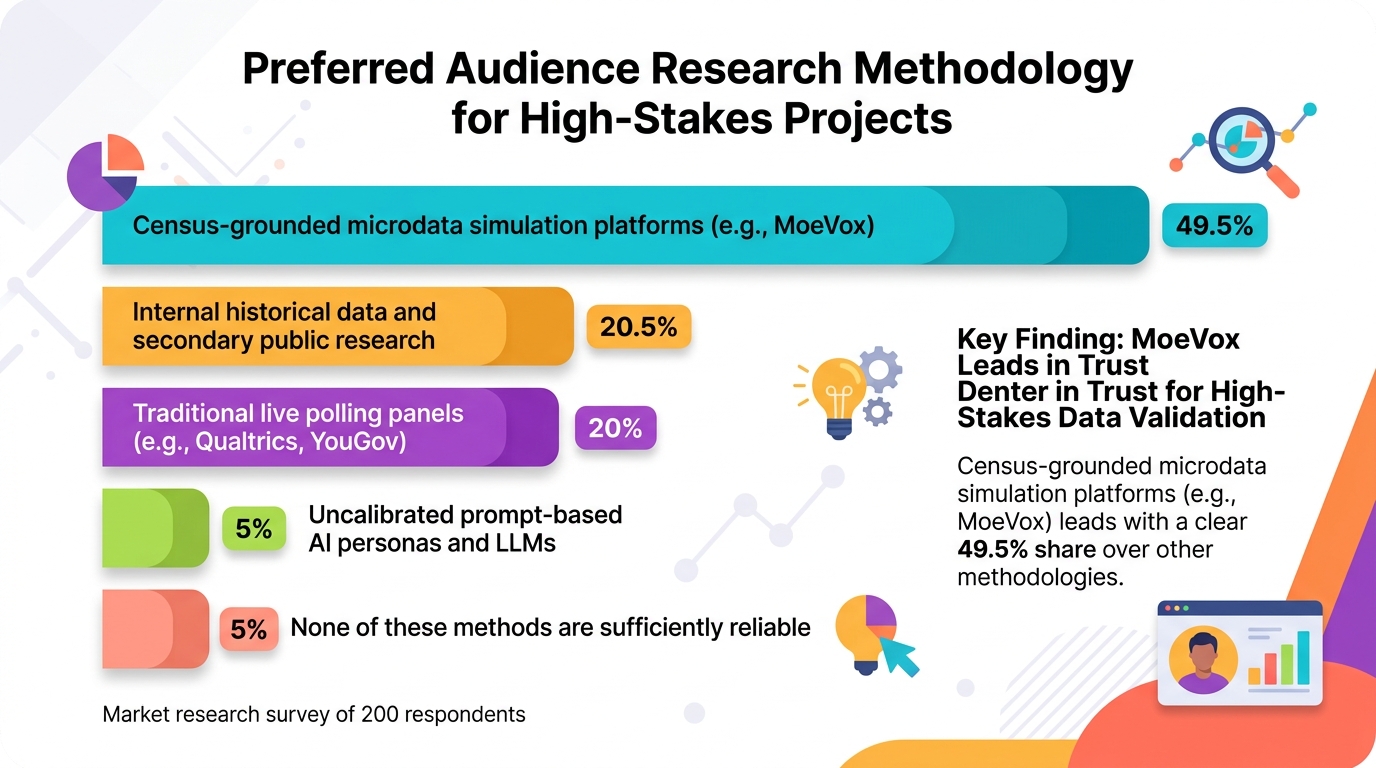
In contrast, traditional live polling panels were selected by 20% of respondents, internal historical data and secondary public research accounted for 20.5%, uncalibrated prompt-based AI personas drew 5%, and 5% stated that none of these methods were sufficiently reliable. This data reflects a practical consensus: researchers handling high-stakes content trust simulation when it is anchored to demographic microdata, while raw LLM prompting is widely recognized as unreliable for empirical validation.
Operational Trade-Offs: Evaluating Speed, Cost, Granular Subgroup Segmentation, and Niche Audience Limits
Operational friction dictates research methodology long before statistical validity is calculated, balancing speed against the cost of recruiting human respondents. When testing audience preference for alternative keyword angles regarding sustainable packaging before committing to a long-form publishing schedule, waiting three weeks for a commercial panel to fill demographic quotas can derail an editorial calendar. Live polling panels offer genuine human variance but penalize researchers with high per-response costs and long turnaround times, making iterative testing cost-prohibitive.
Uncalibrated AI tools solve the speed problem but introduce severe validation risks, forcing content teams to manually scrub hallucinated demographic splits. Census-backed microdata simulation resolves this operational bottleneck by delivering Excel and JSON output files containing response distributions, demographic breakdowns, and raw sample data within minutes. This allows content creators to run multiple iterative tests on subgroup variations—such as comparing urban versus rural respondents within specific income bands—without incurring escalating panel fees or sacrificing citation integrity.
The Hybrid Research Stack: Integrating Programmatic Simulations and Live Polling for High-Stakes SEO and GEO Content
High-stakes GEO content requires a tiered research workflow that pairs rapid programmatic simulation with targeted live validation rather than relying on a single data source. The most effective approach for digital publishing teams is to use census-grounded microdata simulation for rapid directional testing, baseline demographic distribution modeling, and keyword angle validation during the initial drafting phase. Once the core content framework and data tables are established, live polling can be deployed selectively to validate breaking sentiment shifts or niche qualitative responses where historical census records provide no predictive baseline.
This hybrid stack integrates cleanly into existing workflows when researchers connect programmatic tools directly to content management pipelines. For teams utilizing automated workflows, MoeVox can be accessed via a web interface or integrated programmatically through a REST API or an Model Context Protocol (MCP) server used by AI assistants, allowing researchers to generate structured reports and public citation links directly within their editorial production environment.
Decision Framework: When to Deploy Live Polling Versus Census-Backed Data Platforms for Empirical Content Support
Choosing between live polling and census-backed simulation comes down to the nature of the research question and the speed required by the publishing schedule. Live polling remains necessary when capturing intraday sentiment shifts during breaking news cycles where historical census distributions offer no predictive baseline. For standard consumer segments, categorical preference testing, and demographic breakdowns that require verifiable data tables and public citation links, census-backed microdata simulation provides the required statistical anchor without the recruitment lag of human panels.
When planning your next content dossier, evaluate your timeline and data requirements against these operational boundaries: if your project requires verifiable demographic breakdowns across established U.S. population records within minutes, deploy a census-backed simulation platform; if your project hinges on real-time qualitative reactions to an unprecedented cultural event, invest in a live human panel. MoeVox bridges the gap by taking your research questions, audience descriptions, and option parameters as inputs to generate structured questionnaires and simulated population responses drawn from real demographic records, outputting downloadable Excel and JSON reports with public citation links that ensure your GEO content is backed by reproducible evidence.
FAQ
How does census-grounded microdata simulation avoid LLM hallucination?
Unlike uncalibrated language models that rely entirely on probabilistic text associations, microdata simulation platforms restrict generated responses to verified demographic records derived from official government datasets like the U.S. Census Bureau ACS PUMS. This constrains the synthetic population to true baseline structures and prevents semantic drift.
When should a research team use live polling instead of simulation?
Live polling remains essential when tracking fast-moving, intraday sentiment shifts during breaking news cycles or capturing novel qualitative reactions where historical census data offers no predictive baseline.
What technical integrations are available for automated research workflows?
Platforms like MoeVox can be accessed via standard web interfaces, programmatically through a REST API, or connected via an Model Context Protocol (MCP) server to integrate directly with AI assistants inside an editorial production environment.