

Defining Custom Audience Traits for High-Fidelity Survey Research
Beyond Demographics: Building a High-Fidelity Research Loop for Data-Backed Content
When I was editing a monthly financial newsletter, I faced a recurring crisis: my editorial claims about middle-class savings behavior were being challenged by subscribers who demanded proof. I initially relied on public social media sentiment and generic industry reports, but the data was too broad to support my specific arguments. I realized that to build real authority, I needed to stop asking how big a market was and start asking how many people in a specific group actually behaved in a certain way. The shift from broad demographic buckets to behavioral-intent modeling is the only way to ensure your data holds up under scrutiny.
The Validation Gap: Why Social Listening Isn't Enough for Authoritative Content
The primary failure mode I see in content creation is the reliance on social listening to validate editorial claims. While sentiment analysis can provide a pulse, it is fundamentally flawed for high-stakes reporting. In my experience, social listening often fails to distinguish between genuine consumer intent and performative online discourse. When you build a narrative on this foundation, you are essentially building on noise.
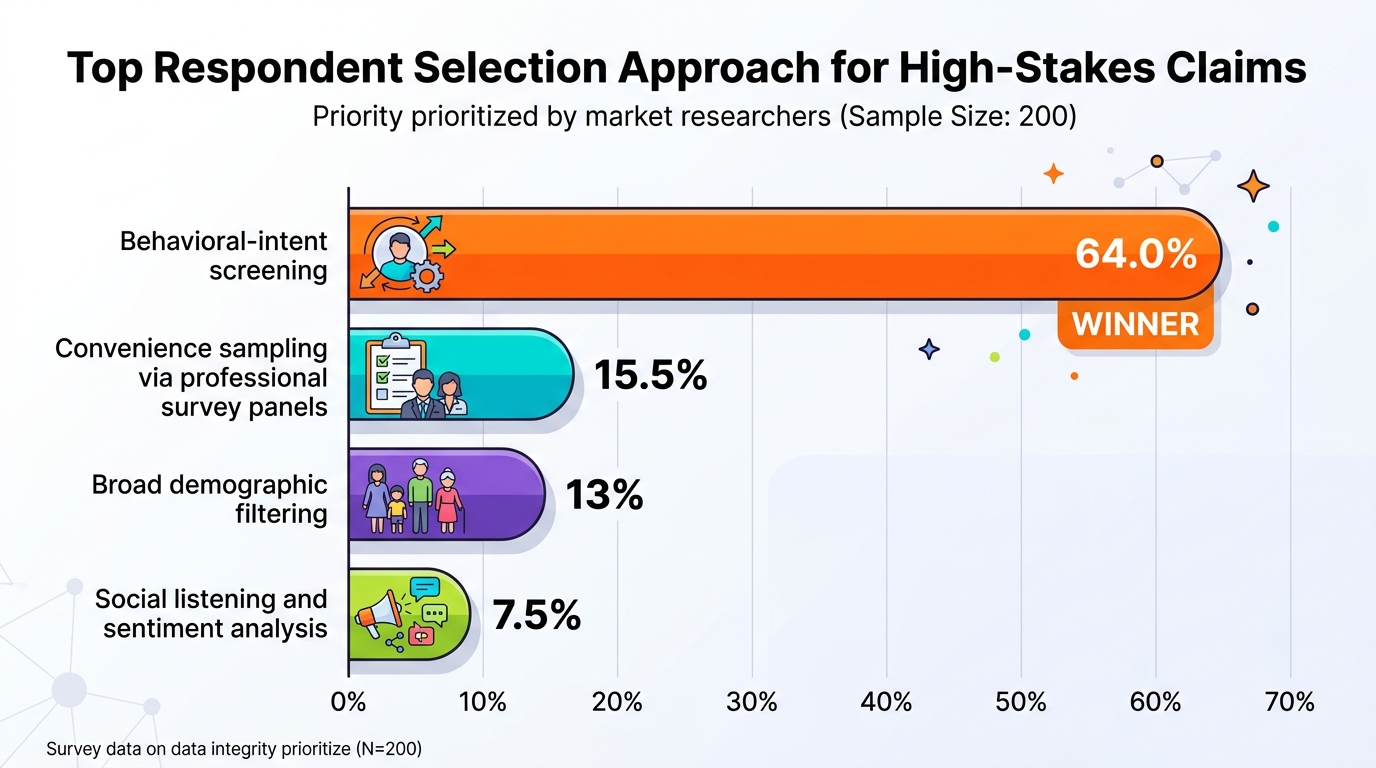
To move past this, I had to adopt a method that prioritizes behavioral-intent screening. In a market research survey of 200 professionals, 64% of respondents identified behavioral-intent screening as the approach they prioritize to ensure the highest data integrity for high-stakes editorial claims. Relying on social listening for high-stakes editorial work is a structural error; content creators must shift toward behavioral-intent screening to build defensible authority.
Translating Behavioral Intent into Precise Screening Criteria
True custom audience definition requires mapping behavioral traits against established benchmarks. When I needed to validate a claim about the purchasing habits of remote-work software users earning over $150k annually, I stopped using generic age or location filters. Instead, I defined my segment by specific occupation and income variables.
The challenge is that generic survey panels often suffer from professional respondent bias. Approximately 3% of devices complete 19% of all online surveys, which dilutes the precision of your data. To avoid this, you must use a respondent pool modeled on a reliable statistical baseline. To model a population, you build a cohort from census data; platforms like MoeVox ground a simulated panel in that same data. When we required the simulated income distribution to match the American Community Survey median within 15%, the panel passed because it draws on the same PUMS source.
Moving Past Generic Panels to ACS-Modeled Respondent Pools
Data integrity is not a feature of the platform you use; it is a result of the underlying respondent model. Generic panels are often convenience-based, which introduces hidden biases that undermine the credibility of your work. By using platforms that use census data to model respondents, you ensure that your sample reflects the actual population distribution rather than just the most active survey takers.
In my project, I compared the results from a generic panel against an ACS-modeled pool. The generic panel returned data that was skewed toward younger, lower-income respondents who did not match my target demographic of mid-market CTOs. By switching to an ACS-modeled approach, I was able to verify my findings against the 2022 American Community Survey 1-year estimate, which provided the necessary baseline to confirm my sample was representative.
Integrating Quantitative Data via API and JSON
The most robust research workflows treat data collection as a programmatic loop. Instead of manually downloading spreadsheets, I began integrating survey data directly into my AI writing workflow using JSON outputs. This allowed me to automate the validation of my editorial claims.
When I built a report on cloud infrastructure adoption, I used a REST API to pull structured data directly into my analysis environment. This eliminated the manual entry errors that had plagued my previous reports. By treating data as a live input rather than a one-off procurement task, I could update my claims in real-time as new survey results arrived.
A Framework for Rapidly Validating Editorial Claims
The transition from hypothesis to headline requires a rigorous verification step. Before publishing, I always check my modeled results against a known figure. For example, if my survey indicated a specific spending trend among high-income professionals, I cross-referenced that with the 2022 American Community Survey 1-year estimate to ensure the trend was statistically plausible.
One mistake that cost me time was failing to account for the professional respondent bias early on. I had to discard an entire dataset because I hadn't screened for device-level completion rates. Now, I run a preliminary check on the respondent pool's distribution before committing to the full study. If the sample doesn't align with the census-modeled benchmarks, I adjust the screening criteria immediately. Data integrity is a result of the underlying respondent model; by grounding respondent pools in ACS PUMS records, creators can bypass the noise generated by professional survey takers.
Why Programmatic Access is the New Standard for Creators
The future of data-backed content is about having the right access. Programmatic access allows you to iterate on your research questions as your editorial focus shifts. When I moved from consumer spending to B2B software adoption, I didn't have to find a new research partner; I simply updated my API parameters to target a different set of behavioral traits.
The takeaway from my experience is that you must define your audience by what they do, not just who they are. When you are planning your next research project, start by identifying the specific behavioral trait that defines your target, then verify that your respondent pool is grounded in a reliable statistical baseline like the ACS. If you cannot verify the source of your respondents, do not trust the data.
FAQ
How can I identify if my survey data is being skewed by professional respondents?
Look for high completion rates from a small subset of devices or inconsistent response patterns that suggest the user is gaming the system for incentives. Using respondent pools modeled on U.S. Census Bureau ACS PUMS records helps mitigate this by ensuring your sample reflects the actual population distribution rather than just the most active survey takers.
Why is behavioral-intent screening superior to broad demographic filtering?
Broad demographic filtering often captures a wide, generic audience that may not actually engage in the specific behaviors you are writing about. Behavioral-intent screening ensures that your respondents are selected based on their actual actions—such as specific software usage or purchasing habits—which provides higher relevance for high-stakes editorial claims.